Followers

Monday, December 17, 2012

Lower Your Unexpectations


“The Hobbit: An Unexpected Journey”
Written by Fran Walsh & Philippa Boyens & Peter Jackson
Directed by Peter Jackson
Starring Martin Freeman, Ian McKellen, Richard Armitage and Andy Serkis
Rated PG-13
169 Minutes


Here it is at last; the long-awaited return to Middle Earth.  After the massive success of his “Lord of the Rings” Trilogy, Peter Jackson has finally delivered the first chapter of his cinematic adaptation of J.R.R. Tolkien’s The Hobbit.  Originally planned for two installments, Jackson somehow managed to stretch the narrative into three films, with the remaining two scheduled to release next year and the year after.  That baffling decision is only one of the reasons that “The Hobbit: An Unexpected Journey” is anything but unexpected.  Instead, when compared to the majesty of Jackson’s “Lord of the Rings” epics, this first chapter of the new Middle Earth trilogy is indulgent, long-winded and uninspiring.

In the opening moments, there is a brief wave of nostalgia upon returning to the Shire and seeing Old Bilbo (Ian Holm) beginning to pen the adventures of his young life.  Indeed, “An Unexpected Journey” begins on the very morning that saw Gandalf’s (Ian McKellen) return in “The Fellowship of the Ring.”  As Frodo (Elijah Wood) scampers off to surprise him, the narrative dissolves to sixty years previous, when Bilbo Baggins (Martin Freeman) is just a young lad with his whole hobbit life ahead of him.  At first, it is a pleasure seeing Freeman capture similar mannerisms to Ian Holm’s portrayal, and his interplay with Gandalf is a nice match to the early moments in “The Fellowship of the Ring.” 

Aside from the initial visual match, “An Unexpected Journey” soon starts putting as much distance between itself and the “Lord of the Rings” films as possible.  Considering that The Hobbit is essentially a children’s novel, Peter Jackson fully embraces that idea with an overload of tonally awkward humor.  The narrative this time concerns thirteen dwarves that have lost their home in the Lonely Mountain to an evil dragon known as Smaug.  These dwarves are really something.  Not only can they wreck and clean a home in mere moments, but they can sing sweetly while doing it.  They’d like Bilbo to come along with them as a ‘burglar’ to reclaim their home and slay the dragon.  They are led by the great Thorin (Richard Armitage), who doubts Bilbo will be of any real help in their journey.  Armitage’s portrayal is something akin to Viggo Mortensen’s Aragorn and is a nice fit for Jackson’s established universe.

Unfortunately, once the titular journey gets underway, it follows a rinse and repeat pattern of predictability and an over-abundance of disastrously obvious CGI.  Filming on location in New Zealand again, it’s as if Jackson forgot what made his “Lord of the Rings” pictures so marvelous; he used the locations to great effect and as much as possible, filmed on practical sets with real actors in fantastic makeup.  The Orcs in “An Unexpected Journey” are entirely CGI, taking away the fierceness that an actor can portray under several pounds of incredibly detailed effects work.  Key locations like Rivendell look like something out of George Lucas’ “Star Wars” prequels, as do silly animal creatures in an early subplot that could easily be excised.  Gone too are the gloriously staged battles, instead replaced with quick-cutting computer imagery.

At 169 minutes, there is something about “An Unexpected Journey” that feels so slight when held up next to “The Lord of the Rings.”  Perhaps the nature of the story hinders itself by following this one group comprising Bilbo and the dwarves the entire time, leaving the larger narrative to feel numbingly inconsequential.  Each chapter of “The Lord of the Rings” follows various races and regions of Middle Earth, creating a cinematic world that feels completely alive and enveloping; but here we are left to endure a series of generic capture and escape set-pieces, the monotony of which is only broken by the always-welcome appearance of Gollum (Andy Serkis in all his motion-capture glory). 

 Stretching out The Hobbit novel to three films smacks of indulgence and Hollywood greed, which is a shame because until now, Peter Jackson has always made magnificent movies.  Alas, you can also catch “The Hobbit: An Unexpected Journey” in 3D and the new 48 fps frame rate.  In 2001, “The Fellowship of the Ring” was nominated for its incredible effects work at bringing to life the characters and locations of Tolkien’s universe.  To accomplish this, Peter Jackson didn’t reinvent the wheel on anything; he used good old fashioned film making to create a groundbreaking epic fantasy.  Will anyone be able to say that about “An Unexpected Journey” in eleven years?  My fear is that these new technologies meant to “improve” the cinema experience will make obsolete the very things that make movies magical.  They sure don’t make them like they used to.     

Monday, December 3, 2012

Even Tough Guys Have it Rough


“Killing Them Softly”
Written & Directed by Andrew Dominik
Starring Brad Pitt, James Gandolfini, Richard Jenkins, Scoot McNairy
Rated R
97 Minutes


Hey, when it’s tough, it’s tough all over; and organized crime is no exception.  Without much subtlety, Andrew Dominik hammers home this idea by framing an allegory for the 2008 financial crisis within a seedy mob drama.  That is certainly an interesting idea, and within the confines of the crime formula, “Killing Them Softly” is a well-made film with a strong director and a talented cast; but its muddled story fails to deliver its ultimate message until the final frame and by then, it feels irrelevant. 
“Killing Them Softly” takes place in 2008 at the crux of the financial collapse and is punctuated every few minutes by archival news footage of President Bush and Barak Obama ruminating on the state of the economy.   At first, it comes across as painfully obvious allegory, but I believe it is a very deliberate choice by Andrew Dominik to convey that the Nation’s crisis was being observed by everyone, even seedy mafia guys.  The problem is that the narrative is stuck in the past along with its relevance.  In 2012, what’s the point in showing an audience your thoughts on an event that was the focus of 2008? 
The actual plot isn’t half bad for a crime picture.  Two low-level thugs, Frankie (Scoot McNairy) and Russell (Ben Mendelsohn), are hired by Johnny (Vincent Curatola) to rip off a Mob card game run by Markie (Ray Liotta).  Johnny assures Frankie that they can easily pull it off because Markie has robbed his own card game before and bragged about it; ergo, the powers that be will blame him again and nobody will be the wiser.  But as these things go, the unhinged Russell runs his mouth to a guy that works for one of the bosses.  Soon enough, Jackie (Brad Pitt) comes to town to whack the two low-level guys, the guy that hired them and even poor Markie; the rationale being that if his games are to keep getting ripped off, it’s bad for business, no matter who’s responsible.  You don’t need a flow chart to discover the parallels Dominik is trying to draw here; the only hard part is figuring out exactly what Jackie is meant to represent.
All of this is handled mostly with extensive conversations containing some pretty great dialogue and in the final scene Brad Pitt makes some observations about America during a monologue that is worth the price of admission alone.  The screenplay is an adaptation of the 1974 novel Cogan’s Trade and had it kept that setting, ‘Killing Them Softly’ might have been a more interesting picture.  In its place is the more obvious and less effective setting of New Orleans in 2008; although the gritty look of the film successfully reflects the depressed environment.  In fact, the movie is full of odd-ball shot choices, with one violent sequence in particular that is strangely romantic in its execution, pardon the pun.  It is a quirky shooting style, highlighted by a great soundtrack and slow motion, making it one of the single most memorable scenes of the year. 
“Killing Them Softly” has had a dismal opening weekend and is now confirmed to be the worst-ever debut for a Brad Pitt movie, which is ironic considering the movie’s central thesis.  I suppose that is just as well, because this is not a great film and doesn’t even come close to approaching the excellence of Andrew Dominik’s previous movie “The Assassination of Jesse James by the Coward Robert Ford.”  In any case, “Killing Them Softly” is full of deliberate choices and has some good moments; it’s just a little late to dinner when it comes to delivering its message with any relevance.  But at least it lives up to its title. 

Tuesday, November 20, 2012

He belongs to the ages...


“Lincoln”
Directed by Steven Spielberg
Written by Tony Kushner
Starring Daniel Day-Lewis, Sally Field, Tommy Lee Jones, David Strathairn
Rated PG-13
149 Minutes


Steven Spielberg’s recent streak of sentimentality fits beautifully into a film like “Lincoln” because it wisely avoids over stretching itself and instead stays focused on Lincoln’s efforts to pass the 13th Amendment in the last few months of his life.  This is a beautiful picture that plays like a timeless portrait of the man who saw past the simplicity of the slavery issue to raise even bigger questions about the nature of human decency.  Being that America has just come out of one of the most intense elections in history, “Lincoln” couldn’t arrive at a better time.  There is a reason Abraham Lincoln still remains perhaps the Nation’s most revered President, and Spielberg’s film symbolizes that perfectly.

At first, Tony Kushner’s screenplay almost seems overly expository with its dialogue; but then the language comes alive, seamlessly adjusting us to the period.  Familiarity with the politics of the time helps, but is not necessary because the story has such a strong focus on one issue in a brief passage of time that it streamlines the narrative.  The issue at hand is the passing of the 13th Amendment, which divided the Republicans and Democrats of the time and was seen primarily as a military measure to end the Civil War.  President Lincoln (Daniel Day-Lewis) is starting on his second term in office and intuitively realizes that the issue of slavery will have implications that reverberate long after the war is over.  He implores those closest to him, including Secretary of State William Seward (David Strathairn) and his wife Mary Todd Lincoln (Sally Field), that in order to again unify the Nation, the amendment must pass. 

Daniel Day-Lewis’s performance is extraordinary.  He is the very embodiment of a President who, stalwart and sleepless, is personable to everyone he meets.  Several times throughout the film, Lincoln conveys important ideas and personal philosophies by telling stories and parables.  He is not above throwing out a humorous quip to sting his protestors and prove a point.  His voice ever-so-slightly betrays his world-weary concerns, which he even tries to keep in check in the presence of his wife, who struggles to keep their son Robert (Joseph Gordon-Levitt) from going off to war.  To balance out the performance scale is Tommy Lee Jones as Thaddeus Stevens, a prominent Republican leader in the House of Representatives, whose flamboyant nature puts everyone else in their place.  It’s a marvelous role for an actor who has had many marvelous roles.

Janusz Kaminski, Spielberg’s long-time collaborator, will unquestionably be another nominee for best cinematography for his work on “Lincoln.”   Kaminski rivals Terrence Malick in the way he shoots with natural light, and there is a stand-out scene here that if I am not mistaken, was lit solely by a lantern.  This is a motion picture that feels very much of the time period it encapsulates and in some ways works as a companion piece to Spielberg’s “War Horse,” which was also shot by Kaminski in a similarly naturalistic fashion.   

One of the most remarkable aspects of “Lincoln” is how necessary it feels, given how palpably our Nation seemed to be divided at election time.  While the history of what occurred with the amendment is a foregone conclusion, Spielberg wisely doesn’t try to spice things up with contrived suspense but instead invites the audience to be party to the intensity of the conversations as we stand witness to the differing positions that were splitting the parties at the time.  The film’s best scene comes when Lincoln sits in a dimly-lit telegraph office dictating to two young men the message he’d like them to pass along.  He asks them a deeply introspective question and then uses one of the mens' answers to convey implications for all of history.  It’s one of the best moments in any movie I’ve seen this year.

While there are perhaps a few too many characters that leave a couple subplots feeling surprisingly inert, Steven Spielberg has crafted a film very much worthy of its title.  “Lincoln” is his best movie in years and comes at a time when our 16th President’s legacy is more important than ever.  Lincoln struggled to make people see past partisan issues and look deeply within the human spirit to find our collective guidance.  Pay very close attention to the last thing he says before departing to his fateful appointment at Ford’s theatre.  The poignancy of his words are haunting; and it makes me wonder what he would accomplish were he alive today.

Friday, November 16, 2012

What Happens After the Dawn has Broken?


‘The Twilight Saga: Breaking Dawn – Part 2”
Directed by Bill Condon
Written by Melissa Rosenberg
Starring Kristen Stewart, Robert Pattinson, Taylor Lautner and Michael Sheen
Rated PG-13
115 Minutes

Not being a fan of Stephenie Meyer’s source material, I must concede that “The Twilight Saga: Breaking Dawn – Part 2” is probably the best possible film that can be adapted from it.  This is by no means great stuff, but as directed by Bill Condon, it wisely expands (and improves) the material lifted from Meyer’s pages and manages to craft a fairly entertaining finale to a series that has been every adolescent girls’ go-to fantasy for years. 

I gave a glowing review to “Breaking Dawn – Part 1” mostly because of its strong focus on the development of key characters and their motivations.  Bill Condon’s direction and the actors’ performances injected the material with some much-needed conviction and specifically, Taylor Lautner’s performance as Jacob was the most compelling aspect of the first chapter.  For its first half, “Breaking Dawn – Part 2” is a lesser film in that regard; for it consists mostly of elements that have hindered the series from the start.  There are new characters, mythologies and plot points that are shoehorned in for the sake of dramatic development and for the final chapter of a series; it seems a bit late in the game to throw in so much new information for the audience to process.  It must be said that these half-cooked, late in the act developments are a product of Meyer’s books and not necessarily a reflection of Melissa Rosenberg’s screenplay. 

“Breaking Dawn – Part 1” ended immediately following the birth of Edward and Bella’s human/vampire hybrid daughter, Renesmee.  As “Part 2” opens, Bella (Kristen Stewart) is now a freshly-minted vampire and aside from contending with her new strength and bloodlust, she must find a way to explain herself to her father, Charlie (Billy Burke).  Without giving away Bella’s secret, Jacob (Taylor Lautner) phases into a werewolf in front of Charlie to help him become acclimated to the possibility of strange discoveries, like why Renesmee (Mackenzie Foy) seems to be aging much faster than she should be.  A point is made that Jacob has ‘imprinted’ on Renesmee; which in werewolf speak means that Jacob is destined to be her protector and someday, potentially her lover.  I think.  He tells a disturbed Bella that it isn’t what she thinks; but it is.  Aside from this development, nothing ever becomes of Renesmee's character and she is side-lined in favor of introducing an onslaught of less interesting ones.  We learn almost nothing of her abilities as she essentially functions as a glorified background character and a MacGuffin for the final act. 

The complications arise because a powerful vampire family known as the Volturi believes that Renesmee is an “immortal child.”  This is a violation of their laws and, led by Aro (Michael Sheen, hamming it up), they come calling to potentially destroy Edward (Robert Pattinson) and his family.  The Cullens travel the globe to assemble various vampire buddies to serve as witnesses to their situation and they also manage to gain the sympathy of Jacob’s clan of werewolves.  This all culminates in a pretty sensational climactic sequence that serves as the best 25 minutes of the entire series.  Bill Condon has taken pretty uninspiring material and instinctively invigorated it with a sequence that almost makes sitting through the first half worth it.  While “Part 1” was a visually superior film, there is imagery here that matches it well and the final shots in particular beautifully capture a sentimentality that will be pleasing for the fans.

For me, “The Twilight Saga” plays better on screen because the actors and two of the directors understand how to utilize the material better than Stephenie Meyer does.  That may be blasphemy to the hordes of devoted fans, but it is what it is.  My hope is that these young actors are given the opportunity to lend their talents to better material in the future.  In any case, this is an ending that should please fans and non-fans alike.  When a film is able to entertain people in both camps, it’s almost as impressive as seeing vampires and werewolves set aside their differences to team up for a mighty battle.

Tuesday, November 13, 2012

This isn't your father's Bond


‘Skyfall’
Directed by Sam Mendes
Neil Purvis, Robert Wade and John Logan
Starring Daniel Craig, Judi Dench, Javier Bardem, Ralph Fiennes
Rated PG-13
143 Minutes


To say that James Bond has aged well would be an understatement.  The character, created by Ian Fleming, has been portrayed by numerous actors over the last 50 years, perhaps none more famously than Sean Connery.  In 2006, the franchise was dusted off and reinvigorated with Daniel Craig in the role of Bond for “Casino Royale” and never having been a true fan of the series until that point, I don’t have much to compare the Craig versions to.  Within that context, Sam Mendes’ “Skyfall” is far and away the best James Bond movie for this generation, with Craig turning in a captivating and challenging performance.  It is also one of the most beautiful pictures of the year, with unforgettable Cinematography by Roger Deakins.


Given that 007 hasn’t really aged since his first Cinematic appearance, it is hard to say if these Daniel Craig adventures are intended as a ‘reboot,’ which seems to be Hollywood’s go-to formula these days.  I think more likely, it is the timeless appeal of sophisticated spy stories that has kept the character alive and well through the generations.  As I recall from “Casino Royale,” Bond was just earning is ‘double 0’ status so technically that makes “Skyfall” the third Bond movie in a series, rather than the twenty-third.  In any case, this is a superb spy thriller akin to the style of the classic Bond films, but injected with a modern action sensibility.  “Quantum of Solace” was a critically maligned offering, as it essentially functioned as a direct sequel to the events of “Casino Royale” and turned James Bond into a revenge-seeking action hero.  I felt there was plenty to like about it, but with “Skyfall,” the through-line is gone in favor of a fresh, self-contained story.  Since that is the staple of the series, it is a wise decision. 


In the opening moments, James Bond is chasing down an assailant apparently in possession of a list containing the identities of deep cover MI6 agents, including Bond himself.  This a breathless beginning sequence, with an incredible motorcycle chase that eventually ends atop a fast-moving train.  Bond’s handler M (Judi Dench) very much needs that list, feeling somewhat responsible for it being out in the open.  In her desperation, she makes a judgment call that leads to 007 being shot by fellow field operative Eve (Naomie Harris).  This turns out to be just the beginning of M’s troubles, which will become more compounded by the new Head of Foreign Intelligence, Gareth Mallory (Ralph Fiennes).  Mallory likes M, but has been instructed to replace her with someone less influenced by years of tough decisions.


Bond returns, not fully recovered, and after making amends with M, sets out to find out who stole the operatives list.  A common thread in this updated series is how vulnerable James can be both physically and emotionally.  In significantly weakened condition, Bond may not even be fit for field duty, but he is motivated by a series of well-executed cyber-attacks intended for M that force MI6 headquarters underground.  Ben Whishaw plays a younger, hipper version of Q and provides Bond with a couple sensible toys that aren’t implausibly high-tech.  “Were you expecting exploding pens?” Q asks at one point, giving a wink to your father’s Bond.  After using his charms on the mysterious Severine (Berenice Marlohe), Bond makes arrangements to be led to Mr. Silva, the apparent mastermind behind the attacks.  Javier Bardem plays Silva with an unhinged and nefarious tenacity; he does for James Bond what Heath Ledger did for Batman as the Joker.  Since his agenda is a personal one, the stakes have never been higher.  There is a tense scene where he explains what rats do when trapped together in an oil drum; besides being one of the film’s best-written scenes, it is elevated by Bardem’s performance to an iconic bad guy moment.


It would be criminal to review “Skyfall” without mentioning the superb cinematography by Roger Deakins, who has collaborated with Mendes before on “Revolutionary Road.”  This should be an easy nomination for the best Cinematography Oscar, alongside Wally Pfister’s work on “The Dark Knight Rises.”  The opening titles in particular showcase at least two unforgettable images that serve as the best the series has ever offered and given the variety of locations, Deakins expertly shifts the mood from scene to scene with subtle color changes and haunting visual cues.  The film’s climax is probably the most well-crafted work I’ve seen all year given its stark location and atmosphere. 


“Skyfall” almost didn’t make it out of MGM’s financial woes alive, but after some studio finagling and a perfect choice of director in Sam Mendes, this is easily one of the year’s finest entertainments.  At nearly two and a half hours, there is a lot of bang for your buck on screen; and guys, if your date has grumblings about this being a “guy movie,” just assure her that Daniel Craig does in fact remove his shirt a time or two.  The only thing missing this time is a definitive “Bond girl,” another staple of the series.  The ending title card assures us that Bond will be back in the future so maybe by then he’ll retain his license to kill and get the girl too.  One thing is certain; his age isn’t slowing him down.

Monday, November 5, 2012

Saving the Arcade, One Game at a Time...

'Wreck-It Ralph'
Directed by Rich Moore
Written by Phil Johnston and Jennifer Lee
Starring John C. Reilly, Jane Lynch, Sarah Silverman and Alan Tudyk
Rated PG
108 Minutes
 

Disney sure knows how to make headlines. Their recent acquisition of LucasFilm Ltd. was the news item of the week, with everyone mumbling about the implications for the "Star Wars" universe. Does this mean Mickey has to join the dark side? Or is the vast empire of Disney too much for even Darth Vader? Financial considerations aside, one thing is certain; Disney still knows how to make a wonderful family feature and they've done it again with the excellent 'Wreck-It Ralph.' This film is an absolute blast, and a love letter to the by-gone "arcade generation." That it is riotously funny as well makes it accessible to anyone looking for a good time at the movies.

The ingenuity of 'Wreck-It Ralph' comes from its classic setting within the world of arcade video games. Those who fondly remember Pac-Man and Frogger will catch the references and in-jokes, but there is still plenty to enjoy and laugh at for people of all ages. The premise also allows for a variety of animation styles and unique visuals, which gloriously shows the creative potential for animated features outside of 3D. You can see 'Wreck-It Ralph' in 3D, but I can assure you it adds nothing to the film and only dims the beautiful color palate.

The Ralph (John C. Reilly) of the title is a character within the arcade game Fix-It Felix, Jr. If you are familiar with the classic Donkey Kong or Rampage, you might get an idea of what this game is like. Ralph's job is to clamber up the side of a building and start smashing it to bits while the building's residents scream in terror. Enter Felix, Jr. (Jack McBrayer), who gleefully strolls in with his gold hammer to repair Ralph's damage. When the building is fixed, Felix, Jr. gets a medal and parties with the building residents while Ralph ends up in the mud before going to bed in the garbage dump next door.

Poor Ralph; this loveable oaf is such a lumbering presence that when he tries to attend a party in the Penthouse of the building he is programmed to destroy, he literally crashes it just by making a humble entrance. He argues that he too could be a hero and earn a medal. When the top floor resident promises him the penthouse if he can pull it off, Ralph sets out to 'game jump,' leaving his own game behind to ride the electrical cord to the power strip, which works as a central hub where characters can enter other games. A stand-out scene has Ralph attending a support group with other arcade baddies like the ghosts from Pac-Man and Bowser from the Mario Bros. games. They even have a bad guy proclamation that asserts "not being good isn't so bad."

Ralph enters a shooting game dubbed Hero's Duty that features a squadron of massive soldiers led by Calhoun (Jane Lynch). Ralph laments the violent nature of the game, but is able to acquire his medal in possibly the most valiant way possible. His journey also leads him to Sugar Rush, a game which blends classic Kart racing with a landscape of endless sweets. Here, Ralph meets a game 'glitch' named Vanellope von Schweetz, voiced by a surprisingly endearing Sarah Silverman. Ralph and Vanellope must team up to stop a series of events that could possibly lead to both their games being unplugged, further complicated by King Candy (Alan Tudyk), who may be harboring secrets about more than just one arcade game.

This probably sounds like a movie intended for a very specific crowd; but 'Wreck-It Ralph' covers so much creative ground that it cuts a swathe of appeal across the entire audience. This is likely the best animated feature of the year, with its brilliant casting and uplifting messages. At its heart, 'Wreck-It Ralph' is a story about acceptance and embracing the obscurity of our own talents. In a time when tragic bullying stories are a daily occurrence, here is a feature with a vital message for all ages. Anyone with a passing recollection of arcade games will be laughing out loud and there are enough contemporary gags peppered throughout to keep adults entertained too. Disney might be swallowing up every franchise property they can get their hands on, but when they consistently put them to good use by combining them into a fun feature like this, who can blame them?

Sunday, October 14, 2012

The Best Bad Idea They Had


"Argo"
Written by Chris Terrio
Directed by Ben Affleck
Starring Ben Affleck, Bryan Cranston, John Goodman, Alan Arkin
Rated R
120 Minutes


Here is another example of a great film whose director is only on his third feature.  Following Rian Johnson’s “Looper,” Ben Affleck emerges with “Argo,” almost certainly a contender for best picture, and surprisingly, one that doesn’t feel like obvious Oscar bait.  That Affleck pulls double duty here by starring is also impressive; this feels like a man in his element and the result is one of the best pictures so far this year. 

Ben Affleck has always been an actor with considerable skill, but since he has stepped behind the camera, first with “Gone Baby Gone” and “The Town” and now with “Argo,” he has proven himself a master talent.  “Argo” also proves that he excels at material that isn’t set in his hometown of Boston and I wouldn’t be surprised if this puts him in extremely high demand for directing any number of features for Warner Brothers.  One of the pleasures of “Argo” is its simplicity; it takes a historical event, sidesteps any complicated political mumbo jumbo, and tells a thrilling and suspenseful story that is easy to understand.

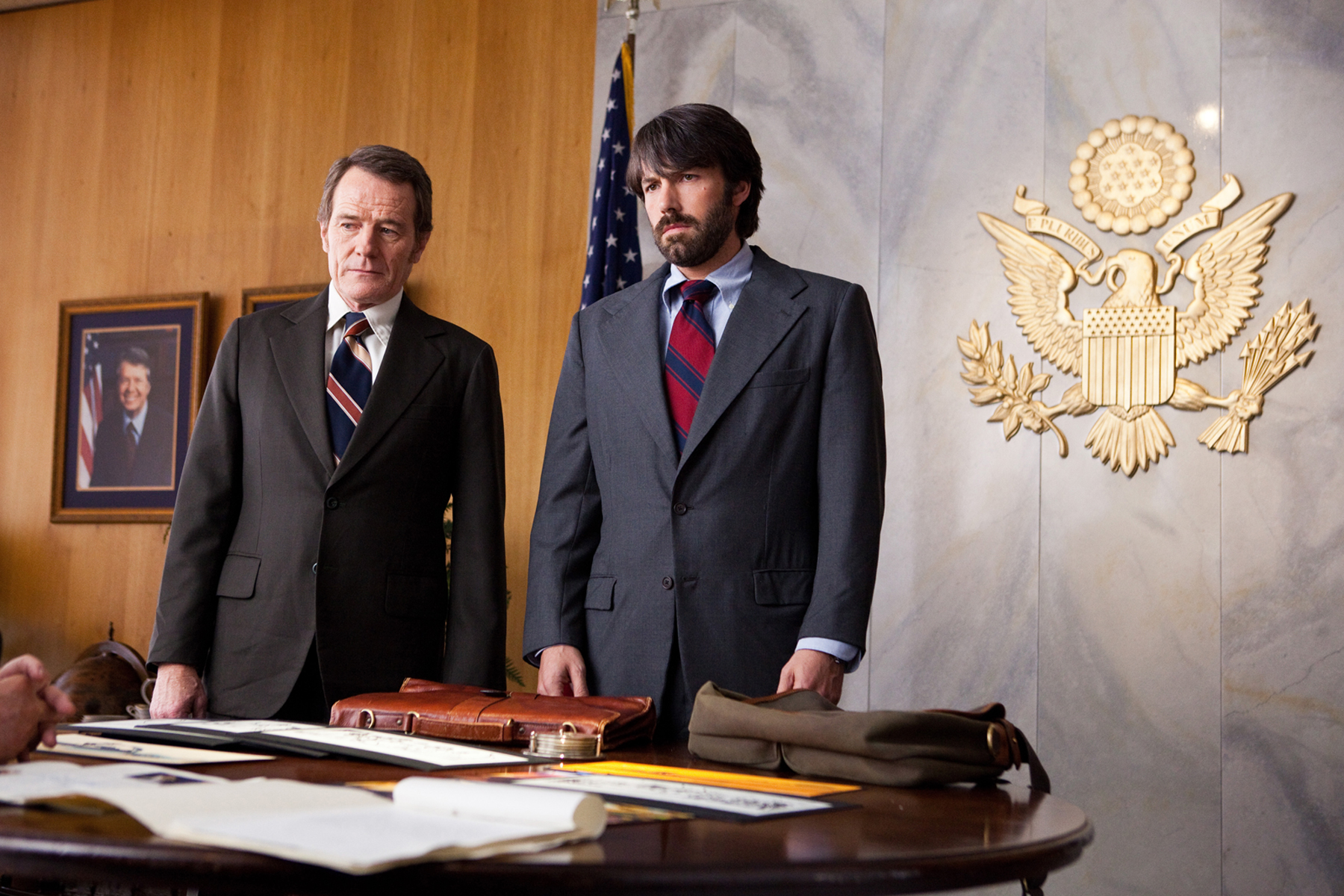
The backdrop for the story is the Iranian hostage crisis of 1979; after America takes custody of an Iranian war criminal, the U.S. Embassy in Tehran is stormed and 50 plus people are taken hostage.  Six Americans escape out a back door and take refuge in the Canadian Ambassador’s (Victor Garber) home.  After 69 days of Iranian troops going door to door looking for Americans, the CIA decides it's time to get them out.  Bryan Cranston plays a CIA bigwig named Jack O’Donnell, who enlists the “exfiltration specialist” expertise of Tony Mendez (Ben Affleck).  Mendez shoots down the CIA’s bright ideas for rescuing them in favor of a far more absurd one; pretend he’s a big-shot Canadian movie producer who flies into Iran scouting for exotic movie locations while the hostages stand in as his Canadian film crew.  Then they’ll all fly out together with Hollywood-issued cover IDs. 

The film’s first act echoes the zaniness of this idea with a screenplay that is refreshingly snappy and relevant.  John Goodman plays make-up legend John Chambers, who takes Mendez to meet Lester Siegel (Alan Arkin), the only producer crazy enough to go for their idea.  “If I’m making a fake movie, it’s gonna be a fake hit” he gleefully states.  They spend some time cooking up an entire paper trail and budget for a bottom-shelf sci-fi movie called “Argo” and try to get the Government to go along with it.  The CIA shows reluctance to the concept but Mendez rightfully asserts that there isn’t a single believable reason for six Canadians to be in Iran during a hostage crisis.  In one scene, Phillip Baker Hall shows up to question the bad idea.  “We only have bad ideas,” Mendez tells him.

What makes “Argo” so compelling is that there isn’t a single scene that feels wasted.  Affleck assuredly balances what is essentially a talky espionage feature with enough tension to make the final act hold you in constant suspense.  Of course the cockamamie scheme worked, history tells us that.  But this will be the first time that many are introduced to the story, and I think Affleck knows that.  The bulk of the narrative is mostly free of action, but the pacing is spot-on and tension comes from brilliant editing that cross-cuts to different locations to show us that the events in one place vitally depend on the events in another.

If “Argo” has a shortcoming, it’s that the six hostages don’t feel fully fleshed-out as characters.  But they are essentially learning new identities within the film so this may be intentional.  In any case, “Argo” is more concerned with the situation and circumstances and provides a wonderful cinematic experience in that regard.  The absurdity of the plot engagingly reflects the realization that this idea actually worked.  It kind of makes me curious what Iran thinks about the movie.  Maybe they won’t allow it in their theatres for fear of embarrassment.  One thing is for sure; they won’t be letting movie crews over for location scouting anytime soon.