Followers

Sunday, October 14, 2012

You Don't Want to Find This Footage


"Sinister"
Written and Directed by Scott Derrickson
Starring Ethan Hawke, Juliet Rylance and James Ransone
Rated R
110 Minutes


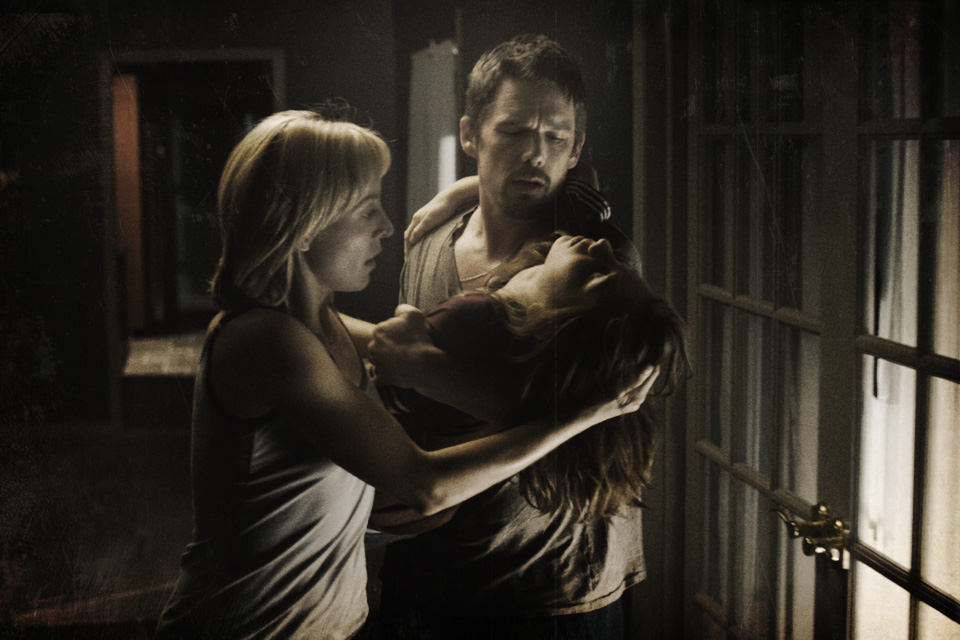
“Sinister” is a unique found footage movie in that it dispels with the usual gimmick by having the main character actually find film footage in his attic.  He spends a great deal of time watching these films on a super 8 projector and what they show is, well, sinister.  The movie as a whole is pretty creepy, assisted by the atmospheric direction of Scott Derrickson; but “Sinister” doesn’t have a great story to tell, with a thin narrative caught somewhere between convention and a bad case of writer’s block.

The film actually introduces us to a writer named Ellison Oswalt (Ethan Hawke), a true crime author that moves his family into a house where a crime took place.  Ellison keeps this information from his wife, Tracy (Juliet Rylance), perhaps because he knows she won’t approve.  After all, they have two children who are at that age where strange behavior is the norm, and the last thing they would need is to be influenced by the grisly details of dad’s research.  So Tracy persists that he must keep his office door locked at all times, and doesn’t seem to mind that he stays up to all hours of the night, every night.  He rationalizes that he hasn’t had a hit book in ten years and this is the story everyone will want to read.  I guess he could have worse habits; like staying up all night to play video games or something.
  
Ellison soon finds a box of family home movies in the attic.  Each canister has a generic label like “family hanging out 98’”, etc.  He figures they might help with his research and begins to watch them in his office in the wee hours of the night.  They are family home movies, all right; they just happen to contain footage of families meeting their end in variously brutal fashion.  I shouldn’t have to tell you that the family that used to live in Ellison’s house is included also, and the film’s opening shot is of four of them being hung from a tree.  I also shouldn’t have to tell you that Ellison discovers, with the help of a Deputy “So and So” (seriously) played by James Ransone, that all the murders on the films are connected.  To deal with this, Ellison does things that don’t make sense, like drink whiskey and ignore his family’s mental health concerns.  I might also add, that if I am a true crime author claiming that the reason I write true crime is to expose the truth and bring justice to the murder victims, and I have a box of murder movies that if shown to the police would do exactly that, then I should consider calling them.  But does Ellison?  To be fair, the screenplay allows him a brief moment to consider it.

The super 8 footage is undoubtedly disturbing and scary, to the point where we are distracted from the fact that not a whole lot else is actually happening.  Oh, all the usual stuff happens, like a floor creaking and a few things going bump in the night.  But none of these events push the story forward.  When Ellison starts to notice a mysterious figure with a freaky face in stills of all the footage, he does some poking around only to uncover a wishy-washy mythology regarding some demon that has no good intentions for children.  To that point, I’ll say that considering the way “Sinister” uses children in the narrative, nobody should allow their child to watch this movie.  Ever.  Trust me; the world has enough problems with misbehaving kids.
  
“Sinister” really isn’t a good time at all.  I guess in retrospect, the sure-handed direction and intense dread really isn’t worth what the movie has to say; which isn’t much.  Oh there are a few decent jump scares and disturbing images that might stay with you but you can get those in any other horror movie, can’t you?  Here’s a thought: “Sinister” has received an R rating by the MPAA but doesn’t contain a single use of the F word or even a bit of sexual content.  This is one instance where I stand in full support of their rating.  They clearly didn’t want kids under the age of 17 to go anywhere near this movie.  And I don’t blame them.

Tuesday, October 9, 2012

He finds them. And kills them. Again.


"Taken 2"
Directed by Olivier Megaton
Written by Luc Besson & Robert Mark Kamen
Starring Liam Neeson, Maggie Grace, Famke Janssen and Rade Serbedzija
Rated PG-13
91 Minutes


The first “Taken” was a lean action thriller that thrived on the hard-edged, tough guy persona of Liam Neeson.   Directed by Pierre Morel, it was the surprise hit of 2008 and the dollars signs it left in its wake all but ensured a sequel.  So follows “Taken 2,” again written and produced by Luc Besson, the very cornerstone of the foreign action market.  Direction this time has been handed over to Olivier Megaton, who sounds more like a transformer than a man.  While it lacks the slick efficiency of its predecessor, “Taken 2” is a competent if irrelevant sequel that still manages to deliver a good time.

The basic premise here is that Bryan Mills (Liam Neeson) used to be a guy with a very particular set of skills.  In the first film, he exercised those skills on just about everyone in Paris in order to rescue his daughter Kim (Maggie Grace) from Albanian sex traffickers.  And, well, really, that’s it.  I suppose you know that he succeeded.  “Taken 2” then, introduces Murad (Rade Serbedzija, apparently the go-to guy when you need a foreign villain), the father of one of Bryan’s victims who wants revenge for his son’s death.  Of course it wouldn’t suffice to just kill Mills and be done with it; he’d much prefer to kidnap his family as well, because that worked out so well for his son and his sex trafficking buddies.  After Bryan completes a job in Istanbul, Kim and Lenore (Famke Janssen), Bryan’s ex-wife, join him for vacation.  You’ll be forgiven for thinking this is a risky move on Bryan’s part, given the events of the first movie.  Although I suppose without all the conveniences of the plot, there would be no “Taken 2;” and Liam Neeson is just too much man for only one foreign country.  Before long, Murad and his goons are snatching up both Lenore and Bryan, who then must utilize his skills to escape and save the day.

“Taken 2” offers the fresh twist of side-lining Neeson for a brief period and actually making the Mills character vulnerable.  This is done in favor of highlighting Maggie Grace as she takes tips from Bryan over the phone in order to surmise his location.  The only problem is, Maggie Grace is not a convincing action star, and her frantic flailing is only a reminder that the film is wasting precious moments by not showing Liam Neeson take out the bad guys.  With the first “Taken,” I felt that things came a little too easy for him; none of the villains were really a match for him and therefore, posed no real challenge or convincing conflict.  But having him tied up in “Taken 2” proves why that idea works so well.  There is really nobody who could carry a movie with this thin of a plot other than Liam Neeson.   Once he gets his hands free and gets Kim to safety, however, the sequel regains its pulse.

Olivier Megaton hasn’t directed many American films, with his only stand-out features being “Transporter 3” and “Columbiana,” both of which are Luc Besson productions.  I even read an interview where he said that he doesn’t really like action movies all that much and his frantic style may be the proof of that.   “Taken 2” is a great deal shakier than the first, with quick-cuts and choppy editing that make for a much more jarring experience.  These qualms aside, it’s still well-choreographed and has the familiar visceral impact of the first film’s action. 

I don’t see much point in comparing “Taken 2” with the first “Taken” because it’s not exactly like that one was a masterpiece.  If you go for the sheer pleasure of watching Liam Neeson strong-arm his way through countless bad guys, then by all means, this is what you’re looking for.  The worst you could say about it is that isn’t quite as surprising or as engaging as the original.  You can attribute that to a lesser director or to a “been there, done that” script, but whatever you do, don’t you dare blame Liam Neeson.

Wednesday, October 3, 2012

The future is the past is the future.


"LOOPER"
Written and Directed by Rian Johnson
Starring Joseph Gordon-Levitt, Bruce Willis, Emily Blunt and Jeff Daniels
Rated R
118 Minutes


Director Rian Johnson has only three major films under his belt, but with each effort has proven hismelf a prodigy.  "Looper" is his third feature film as both writer and director and once again shows his ability to infuse genre pictures with inginuity and smarts.  His "Brick" was a grim gumshoe detective story set in a contemporary high school and "The Brothers Bloom" was a sleek heist movie that made excellent use of its locations.  Now here is "Looper," which on its surface is a time travel sci-fi film with a stellar cast and gorgeous visuals.  At its core, however, is a surprisingly moving tale about  self-regret, sacrifice and the importance of parenting.  The slogan for the movie is actually quite clever at selling two of "Looper's" strongest themes: 'Face your future, fight your past.'

The movie begins with an informative voice-over by an assassin named Joe, played by Joseph Gordon-Levitt in his third big role this year.  Joe isn't your average assassin; he helpfully explains that in thirty years, time travel will be invented and immediately outlawed.  A futuristic mob syndicate will illegally use time travel to send targets thirty years into the past to be eliminated by the assassins, which the movie dubs 'loopers.'  With me so far? Joe is a looper in 2044, which serves as the present setting.  His boss, Abe (Jeff Daniels) was sent back from 2074 to supervise the loopers and make sure that their targets don't escape. This step is especially important when it comes time for the loopers to 'close their loop,' which is a professional way of saying that they must kill their future selves to ensure that all traces of this operation are erased.  Doing this comes with a substantial pay-out that allows the loopers to retire and live the good life for the next 30 years.

This raises the first of many moral complications that "Looper" dabbles in.  You see, if you took a job as a looper knowing that eventually one of your targets would be the older version of you, could you actually live happily for 30 years with the knowledge that your life is to be cut short?  Not only that but that your murderer would be....you?  Rian Johnson's exceptional screenplay somehow keeps these ideas manageable but no less intriguing.  Early on, Joe is asked to either give up his friend Seth (Paul Dano), who has let his loop escape, or give up half his savings, which he sincerely hopes to use to retire to france upon closing his own loop.  Joe's conversation with Abe is intimidating and strangely tender, but it has a logic that seemlessly stays true to Johnson's established ethical foundation.

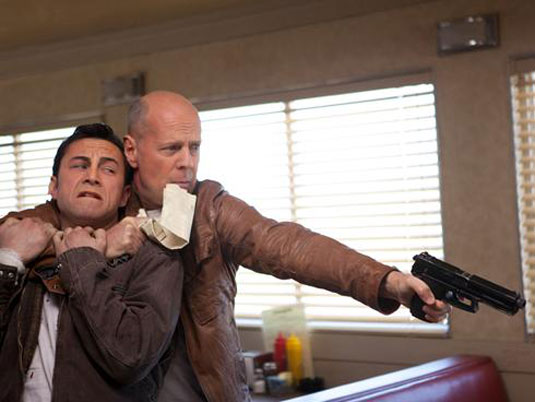
It is not a spoiler to reveal that Joe's older self, played by Bruce Willis, eventually is zapped back for assassination.  The twist is that he doesn't have a hood on, so when young Joe hesitates, old Joe gets the upper hand and escapes.  This jump starts the film's middle act, which sometimes resembles "Minority Report" in its sci-fi sensibilities and sometimes resembles film noir in its tonal resonance.  By far the film's best scene is in a rural diner where the two versions of Joe meet for a vital conversation.  Young Joe knows that he must kill old Joe, and his conviction is strangely hypnotic; we kind of see his point.  It is his job, after all.  Old Joe must know that at some point, he used to be the young Joe that sits before him now and he lectures young Joe that he is naive and has a lot of growing up to do.  That Johnson takes time with this dialogue is such a smart move, because it allows us to reflect on our choices and regrets.  30 years from now, are you going to be able to say you made the right choices when you were younger? 

I can say no more of the plot but to simply mention that no matter how many times you saw the previews for "Looper," most of where the movie goes will be a complete surprise.  Emily Blunt delivers an intriguing performance central to the third act, but basically all of that development has been succesfully concealed by the previews.  This is one case of marketing that serves the picture well.  "Looper" undoubtedly requires more than one viewing, at the very least because there is so much to appreciate.  Oddly enough, the time travel mechanism is probably the least complicated aspect in the entire narrative.  Rian Johnson plays in familiar territory but incredibly doesn't leave the paradoxes and questions hidden; rather, he embraces them and centers some of the film's key sequences around them.  When the film does employ visual effects, they are not distracting and it is nice to see a director who knows how to use slow motion properly.  The make-up used to transform Joseph Gordon-Levitt into a young Bruce Willis is uncanny and his performance easily sells the notion that he is the younger version of the same man. 

Joseph Gordon-Levitt is having a stellar year with three major films already delivered, and "Lincoln" premiering in November. Thankfully, by sticking with the likes of Chris Nolan and Rian Johnson, his talents are being utilized well.  In fact, "Looper" almost works as a companion piece to "Inception" in that it proves that sci-fi blockbusters need not be filled with constant explosions and CGI to be entertaining, but can excel based off original ideas.  My hope is that Rian Johnson stays true to his own convictions and doesn't get caught up in the studio mechanisms of Hollywood.  "Looper" is a perfect example of what happens when a director is allowed to maintain their creative integrity and something tells me that before he succumbs to studio pressure, he'd close his own loop.

Monday, September 3, 2012

No Law and Order In This County


"Lawless"
Starring: Shia LaBeouf, Tom Hardy, Jason Clarke, Guy Pearce and Gary Oldman
Written by: Nick Cave
Directed By: John Hillcoat
115 Min
Rated R


Anytime a film boasts that it is 'based on a true story,' you can almost guarantee that it has been stylized for dramatic reasons.  Rarely is the reality of a historical event anywhere near as action-packed as the way it is reflected on screen.  Given that, I don't know how much the events of "Lawless" reflect the reality of Franklin County Virginia circa 1931, but that isn't the point.  More accurately, I believe "Lawless" portrays a prevailing attitude about the circumstances in Franklin County Virginia circa 1931.  An attitude about crime during prohibition, an attitude about family loyalties and an attitude about Government controls on particular commodities.  It plays with strong themes and has a stellar cast delivering riveting performances, but with a spotty narrative structure and an ending that doesn't play true to the rest of the film, it lacks the conviction of some of its own characters.

I've often wondered why people don't use the Prohibition as an example to show the great fallacy of Government "controls."  When a commodity (like alcohol, marijuana, guns, etc) is readily available, anyone, within reason, can acquire it.  There are licenses in place to moderate the sales and providers of guns and alcohol, but for the most part, nobody need resort to criminal behavior to access them.  Most certainly, alcohol can be a danger when consumed irresponsibly.  It can also illicit violent behaviors in certain individuals (a small percentage of them, in my experience and estimation).  Yet it occurs to me that a great deal more violent crime was committed when the Government banned alcohol in 1920.  When you ban something that a lot of people want, they will resort to extreme behaviors to continue to acquire it.  This includes murder, brutal assault, blackmail, bribes, pay-offs and intimidation.

"Lawless" plays around with these ideas and is provided a great screenplay by Nick Cave, who is collaborating for the second time with director John Hillcoat.  They worked previously on "The Proposition" which is also a bleak rumination on the nature of violence forced by circumstances.  "Lawless" lacks that film's perfect pacing and intensity, but still bares the mark of a talented creative team.  There is a particular look one imagines when considering the 1930s and "Lawless" captures that perfectly.  The film takes place in Franklin County Virginia, dubbed 'the wettest county in the world' due to the fact that everyone there was brewing some form of alcohol or another.  Particularly skilled at Moonshine production are the Bondurant brothers; Forrest (Tom Hardy), Howard (Jason Clarke) and Jack (Shia LaBeouf, giving easily his best performance to date).  Forrest is the responsible one; strong and mostly silent.  He is built around a particular, but never too defined set of principles.  For instance, when Jack is brutally assaulted, Forrest calmly gives him a "man-up" sort of speech rather then foolishly seeking revenge. Howard is perhaps a bit unhinged, carrying around a grudge brewing just under the surface that he keeps at bay by constantly sampling their specialty product.  Jack, the youngest, desperately wants to impress his older brothers and carry his share of the weight, although he sorely fails to grasp what exactly that could entail.  Maybe he is too distracted by the comely Preacher's daughter (Mia Wasikowska).

Pretty soon, a tyrannical "Special Agent" comes nosing his way into the County.  This is Charlie Rakes (a sneering Guy Pearce), who quickly disrupts the flow of previous local arrangements by intimidating the local police, who were more than happy to buy from the Bondurants, but now torment them out of fear.  Gary Oldman plays local crime boss Floyd Banner, who is willing to oblige local competition as long as they don't step on toes.  Unfortunately, Oldman makes only a few brief appearances and his role is never made completely clear.  An always welcome Jessica Chastain plays Maggie, a new hire at the Bondurant restaurant, which serves solely as a cover for the real source of income.  Of course, once Charlie Rakes realizes who all the players are, he uses his sinister slickness to inspire a great deal of violence and retribution.  The best moments involve Tom Hardy's Forrest, who won't be muscled or pushed around by anyone; he'd prefer to just not be touched for that matter.  Indeed, Jack believes his eldest brother is tough to the point of being invincible.  As Jack, Shia LaBeouf abandons his usual goofy energy for a very subdued and vulnerable performance.  His arc is the most compelling in the film.

"Lawless" is an adaptation of "The Wettest County in the World," a novel by Jack Bondurant's grandson Matt.  Keep in mind a novel isn't exactly a diary of actual events, and I am suspicious that maybe much of what happens here is what Matt imagined as he was told stories of the Bondurant brothers of 1931.  Even so, it is compelling enough that these men existed, and intriguing to consider that even part of the way they are portrayed here might be based on reality.  Prohibition was a dark time for the entire Country, but if Franklin County really was the 'wettest' then I imagine things were pretty rough.  And that provides my biggest complaint of the feature; in such a viscerally violent film, boiling over with tension and bitterness, the ending plays it safe by churning out a standard Hollywood resolution.  Well, I suppose you could argue that it's bitter-sweet, but either way I didn't buy it.  I am not one of those who requires to be let off easy and I wonder if the studio execs ordered a re-worked ending.  Oh well.

"Lawless" is an entertaining two hours.  Its greatest strengths lie with the talented cast and crew and they have provided a mostly terrific period film about prohibition.  It could sit nicely alongside "The Untouchables" and "Road to Perdition" as one of cinemas' finer examples.  While there are some structural issues with the pacing, mostly due to some questionable character roles, everything else is good enough to distract from it.  But as I said, "Lawless" is more about attitude and in that regard, it superbly examines the violence that a misguided Government ban inspires.  I wonder how someone like Forrest would do as a gun runner or marijuana dealer.  Something tells me he'd be a great spokesperson advocating for the legalization of marijuana, although he wouldn't have to say much.  When the guy who has played a fierce MMA fighter, a hardcore moonshiner and Bane comes around, I'd do what I was told.

Thursday, August 23, 2012

A living, breathing masterpiece.

"The Concept of Life"
Starring: Savannah Self, Clayton Self and introducing Evelyn Grace Self
Directed By: Dr. Sand, KVCH Nurses
Written By: Proud Parents
Rated: Perfect
Running Time: Forever Please

One of the great pleasures of being a brand new dad is that you are probably the only one in the room at the time of birth that gets to observe so many things at once.  Mom, valiant and courageous, is pushing through immense pressure and focused almost exclusively on delivering the life that has grown within her for 9 months.  The Doctor is expertly navigating that new creation through life's arrival gate.  There are Nurses and family members coaching mom; assuring her that the worst pain has indeed passed and that after just a few more breathless seconds, she will have her reward.  But fathers have varying levels of involvement.  Some might have a medical fascination with the process and may be actively engaged in the current pursuit to usher in a new life unharmed.  There are others that stand near mom's head, secretly hiding a racing heart rate and a million thoughts beneath a calm exterior.  While I can state firmly that I am in this latter category, it encompasses much more that it implies, and certainly more than could ever be expressed in written or spoken word.

Even as I sit writing this in the very room where my daughter's life began, watching her slowly rise and fall on my wife's chest, words escape me.  Breath comes only because life requires it and my brain tells my body to do it.  My entire consciousness rests symbolically within this tiny extension of myself, and the contribution of my genes is only half of what makes her a miracle.  Hearing the words of others, many of them the same, could never do this justice.  People use the common cliches to express happiness or strangely encouraging words of doom.  "Say goodbye to sleep as you know it" they say.  Maybe they see this is as a negative thing, but I think my heart stopped as our daughter took her first breath, and after that, who would want to waste time sleeping?  The hardest part to me is the feeling of helplessness every time she cries; or the way every touch betrays my lingering lack of confidence.  How do you bring this perfect being into the world, with all there is to understand, when you don't even yet understand it?  I know these fears will subside, but in the meantime they are contained in a single room, like a perfectly safe bubble surrounded by chaos.

There are several random bits of knowledge a man can take away from his first day of fatherhood.  Almost like chapters, the day of birth is punctuated by phases of emotion.  When I was told Savannah was dilated to 5 centimeters, no force on earth could have slowed me down from the speed at which I was scrambling to make sense of what was about to happen.  I have never taken LSD but from what I have read on the affects, this scenario may have been comparable.  On the way to the hospital, my hallucinogenic state made me perceive traffic as moving slower than it ever has.  Simple things like pressing the gas pedal suddenly had a manic sense of priority.  Luckily, the parking lot presented relatively few challenges.  Then immediately upon seeing my laboring wife, phase two started and the necessity to remain calm took over.

One of the fun parts amid all the fury of delivery day is the dictionary's worth of terms there are to learn.  Just having become used to the term "Lactation Consultant," which could potentially be the best job title in existence,  there are new gems like "Phlebotomist," which sounds ominously like some sort of mucusy circus performer.  Fortunately, for needle-phobes like myself, the entire delivery was carried out relatively needle free.  In fact, the biggest point of pride for the day was not even my own, as my wife braved intense contractions and 17 minutes of pushing completely free of medications or an epidural.  The only trouble came when the baby's heart rate dropped, momentarily spinning me into a panic as the medical staff instantly snapped into their successful routine that lead to a safe birth for both mom and child.  Then, at the very instant her head was fully visible and I first heard her cries, my heart stopped and my immediate tears told me all I needed to know.

Right now, more than 24 hours after Evelyn's birth, my arm is throbbing from a 'Tdap' vaccine; yet another small step to help the health of this new life I get to share responsibility for.  I am surrounded by the people who have always been most important to me and a new one who's value cannot be calculated, who's meaning cannot be measured and who's importance I will spend my life trying to live up to.  My heart now beats outside my body and it has never beat as strongly or as purposefully.  I feel that to adequately compile my entire range of feelings and thoughts, I would have to write something much more substantial in length, but it would take the better part of an eternity to read it.  Besides, the limitations of human expressions and vocabulary aren't enough.  Becoming a father has diminished every thought I ever had about what it truly means to be a man.  Lucky for me, I have the perfect example of human life breathing just a few feet from me and through her I will learn what it means for the first time.

Sunday, August 12, 2012

More Like "The Bourne Addiction"


"The Bourne Legacy"
Written and Directed by Tony Gilroy
Starring Jeremy Renner, Rachel Weisz, Edward Norton
PG-13
135 Min

"The Bourne Legacy" is either a sequel to the first three Bourne movies, or it is a spin-off.  I can't quite say which because while it works well enough as a spy thriller, it has some trouble incorporating the familiar Bourne brand name.  The problem isn't in the casting, which replaces Matt Damon's Jason Bourne with a new character named Aaron Cross, played by Jeremy Renner.  Renner has been making the rounds in a great many blockbusters over the last few years, and he is a welcome presence.  The issue lies within the film's identity crisis.  The first hour or so is made up of scenes of Cross in the Alaskan wild, intercut with scenes we saw played out in "The Bourne Ultimatum."  Therein lies the rub; because even though the tone of this feature fits nicely into the established Bourne film universe, it is too tied down to the previous installments, and does nothing to move the story forward.

Obviously, if this is meant as a spin-off, we'd expect to be carried along by a new narrative that could stand independently of the previous films' events.  Instead, "The Bourne Legacy" bites off more than it can chew by attempting to branch off in a new direction, and simultaneously treads lightly with the new story in favor of leaning on the more compelling events surrounding Jason Bourne.  David Strathairn, Albert Finney and Joan Allen all show up very briefly to reprise their respective roles, which is all well and good, but they are gone so quickly that it makes us wonder why they were included at all.  We also see footage from "The Bourne Ultimatum" which conveniently leaves out any scenes of Matt Damon.  The result is a first half that almost forces the audience to distract themselves by trying to piece together events from the last movie, which takes us out of this one.

The new story involves Aaron Cross (Renner), an operative for the 'Outcome' program, which if I understand it right is a subsidiary of the 'Treadstone' program that Jason Bourne was a product of.  The difference here is, the Outcome agents are enhanced by pills that are taken at regular intervals.  There is a green pill for physical enhancements and a blue pill for cognitive improvement.  These 'chems,' as the screenplay calls them, are manufactured at a Government lab where Dr. Marta Shearing (Rachel Weisz) works.  For nearly the first hour, Aaron Cross is trekking through the Alaskan wilderness, apparently as punishment for insubordination or something.  He is running low on chems and seems to need a new dose really bad.  Meanwhile, as a result of Jason Bourne exposing Treadstone with the help of Pam Landy (Joan Allen) in the last film, Ezra Kramer (Scott Glenn) fears that similar unsanctioned Government Operations may be at risk.  Retired Colonel Eric Byer (an always welcome Edward Norton) is informed of the situation and immediately decides to eliminate all the agents for Outcome.  This is done by replacing the agents' chems with a single yellow pill that brings death in the form of a left nostril nosebleed.  Since Aaron Cross is unreachable in Alaska with another agent (Oscar Isaac), Byer and his goons send a drone to explode things. With the help of some wolves (don't ask), Aaron is able to make it appear as though the drone was successful.

I've often wondered in these features why the best strategy for hiding the shady dealings of an unsanctioned Government Op is to leave a trail of mysterious deaths.  Since the brainwashing recruitment strategy has already been established, wouldn't it be more conducive to make the agents promise to never tell in case things go south?  But nevermind.  Aaron is able to make his way to Marta's home just in time to save her from some unsavory "mental health professionals" who intend to permanently remedy her trauma from a recent workplace tragedy.  Together, Aaron and Marta go on the run from everyone who wants them dead and this is where the film starts to lose its trajectory.  You see, Jason Bourne had amnesia when we met him in "The Bourne Identity" and part of the fun of following his journey was that he needed to find out who he was.  While Aaron Cross certainly has something to run from, he lacks a clear goal or motivation outside of drug addiction.  His whole reason for sweeping Marta along is so that he can get more pills; until Marta informs him that there is an injection form of each chem that can "viral off" the enhancements, making them permanent.  Even better.

Once they reach the lab in Manila and get the vaccines, then what?  "The Bourne Legacy" has a hard time answering that.  It spends the last act mixed up in rooftop parkour, motorcycle chases and shoot outs.  There is even an assassin sent to kill Marta and Cross who is so skilled that one of Eric Byer's colleagues has "never seen evaluations like this."  Mmmhmm.  So talented is he that after clumsily chasing them in plain sight, he is easily and brutally dispatched by none other than the timid Marta.  I give away this detail not to spoil your enjoyment, but to lower your expectations of anything as cool as what we've already seen in the first three movies.  While the action is exciting, it is brief and infrequent, and because we don't really understand what the main protagonist is trying to accomplish, it gives no sense that anything is at stake. Then, to top it all off, the movie just ends before setting up any kind of connection to let us know precisely what the "legacy" referenced in the title is.  What is clear is that sequels are intended; perhaps with Matt Damon and Jeremy Renner teaming up to take down the whole conspiracy.

Tony Gilroy, who has provided the screenplay for all the "Bourne" feature films, also directs this one.  At that, he is accomplished.  His "Michael Clayton" was one of the best pictures of 2007, and his smart writing takes center stage here in a very talky movie.  That would be great if there was a sense of momentum to what's being said.  Instead, we're given a competent action film, with little in the way of action, that relies too heavily on our enjoyment of the original three "Bourne" adventures.  No surprises if some viewers feel swindled when they walk out of the theatre.  I might give it another watch just to see if my perception is different the second time around.  Maybe I'll take one of those blue pills before going.

Saturday, July 21, 2012

The Darkest Knight Yet


"The Dark Knight Rises"
Directed by: Christopher Nolan
Written By: Jonathan Nolan & Christopher Nolan
Starring: Christian Bale, Anne Hathaway, Tom Hardy, Gary Oldman, Joseph Gordon-Levitt
Rated PG-13
164 Minutes


The biggest problem facing "The Dark Knight Rises" is that it isn't "The Dark Knight."  Christopher Nolan's 2008 crime epic came out of nowhere to shock and delight audiences who weren't expecting the sequel to "Batman Begins" to be so sensational.  It caught everyone off guard and remains a nearly perfect film elevated by the iconic performance of Heath Ledger as the Joker.  The obvious expectation this time is that Nolan must justify the final chapter of his trilogy with something bigger and better than "The Dark Knight."  Mixed reviews might convince you to lower your expectations, but I think all it requires is different expectations.  In its first hour, "The Dark Knight Rises" may lack the initial visceral impact of its predecessor, but what slowly emerges from the perceived rubble is an absolute masterpiece.

This final entry in Nolan's "Dark Knight" trilogy is actually the most methodically structured of all three.  It hits the ground running by introducing all the familiar characters, and at least four new and prominent ones.  Having too many new characters in the concluding chapter of a trilogy can be the kiss of death if handled incorrectly.  Luckily, Christopher Nolan has 2 hours, 45 minutes to find something for each of them to do and casts big name actors to make sure that even in their briefest moments, they leave an impression.  Arguably the most significant addition is Selina Kyle, who is oddly well-defined for being such an ambiguous character.  Anne Hathaway plays her with a deep charisma masked by a playful tenacity and when we first meet her, she is posing as a waitress to sneak into Wayne Manor's east wing, where Bruce has been a recluse for several years.  He is so spiritually broken from the events of "The Dark Knight" that even The Batman hasn't been seen in 8 years.  This is Christian Bale's strongest performance as the character and will likely stand as the definitive one should somebody else snag the role in the future.  Michael Caine is back as well, providing some of his most emotional work to date as Bruce's ever-faithful Butler, Alfred.  In one conversation with Bruce, he rescinds on a promise he made to him in the first movie.  His reasons are sound, but the choice that he makes is probably the film's most heartbreaking moment; and there a lot of those.

Meanwhile, Commissioner Gordon (Gary Oldman) has been living under the weight of the lie he and Batman concocted to prevent the public from finding out the truth about Harvey Dent's crimes.  Oldman has played Gordon as a moral force for good in the previous films and with that moral compass bent just slightly too far, Gordon loses focus in some early scenes here, and pays dearly for it.  Under his command is a new Gotham City Police Officer named John Blake (Joseph Gordon-Levitt), who knows a vital piece of information that he quite honorably keeps to himself.  There is also Miranda Tate (Marion Coutillard), an environmentalist and board member for Wayne Enterprises who has a hand in a vital clean energy project.  She works with Lucius Fox to keep this technology from falling into the hands of John Daggett (Ben Mendelsohn), a Wayne Enterprises rival who has used his wealth and resources to bring a terrifying mercenary known as Bane to Gotham City.  Tom Hardy is absolutely ferocious as Bane, if not quite as memorable as Heath Ledger's Joker, or as well-defined.  What is clear is that Nolan and Hardy had different intentions for Bane altogether, and he holds in store a horrifying fate for Gotham City.  While the Joker's reign of terror had a great deal to do with the Batman, Bane will see his plans through whether Batman is around or not. 

This is all dense plotting in a film that initially feels too long with the first viewing.  Some characters drift in and out of the narrative, sometimes absent for significant stretches.  But the movie covers a lot of ground and I am certain that Christopher Nolan has left nothing to chance and made specific decisions for a reason.  Symbolically, he has structured the narrative to be a little jarring, to echo the overall sense of unease.  Then when things start hurtling toward the heart-stopping climax, Nolan reveals his hand, giving every character their due and placing them exactly where they need to be.  A vital part of the film's final act is the score by Hans Zimmer, which elicits a powerful emotional response to accompany the thrills of the plot.  Perhaps the title for the film was influenced in part by the trajectory of the score, which has taken a new direction from the previous films.  It is an elegant piece of work. 

The palette of the film itself is exponentially grander this time as well, with Wally Pfister returning as director of photography.  When Chicago stood in for Gotham city, he had a distinct color scale and framed shots so that a familiar city was creatively disguised.  This time, Gotham is a hybrid of New York, Pittsburgh, and Los Angeles; and even though this provides a new look to the film, it successfully reflects the change of genre.  Nolan has stated that he wouldn't do a third Batman picture unless he could top the grandeur of "The Dark Knight." In terms of scope and scale, he has done exactly that.  If  "Batman Begins" is a focused, fear-driven, psychological character study; and "The Dark Knight" a bold crime drama; then "The Dark Knight Rises" is Chris Nolan's disaster epic.  Each film could stand independently and fit into a particular genre, and I think that's why Nolan chose to come back to the story twice; because each chapter of his Dark Knight saga has resonated with its own self-contained theme.  If he had restricted himself to making simple sequels, he would have had nothing new to offer and they would have played as needless rehash.  The brilliance of this trilogy is that it has spanned genres, becoming so much more than what its source material would suggest.

Even at 164 minutes, "The Dark Knight Rises" will reward repeat viewings.  It serves as a definitive end to be sure, but it still leaves excellent questions.  The last shot in particular must have been meticulously planned and it does a fantastic job of wrapping up everything that has come before while simultaneously leaving us with ideas about what the future will hold.  Chris Nolan will not be returning to the universe of the Dark Knight, but he has provided three films with a captivating interpretation of the character.  This could easily stand as one of the greatest trilogies put to film, and it goes without saying that it is the most significant in the comic book universe so far.  I just hope that audiences will not hold this final chapter under too much scrutiny in comparison with "The Dark Knight."  It is a different kind of film and should be allowed to stand or fall on its own merits.  One thing is for sure, from beginning to end, it rises to the most emotionally exciting climax I have seen in a long time.  There is a really nice moment early on where Selina warns Bruce that a storm is coming.  He wonders if she might be looking forward to it; to which she replies: "I'm adaptable."  Looking back over the director's relatively short list of films, she could easily have been describing Christopher Nolan.  Now that he has finished telling this story, with whatever he does next, I'll be looking forward to it.