I was slightly concerned that by the time I saw 'Captain America: The First Avenger,' I would feel like I had already seen too much of it. The movie was heavily over-marketed; undoubtedly because of its opening date just a week after the finale of 'Harry Potter,' the studio was concerned it might not perform above that momentous event. Well, the bombardment of trailers and t.v. spots seems to have paid off; 'Captain America' did indeed triumph in it's opening weekend. The final Marvel champion before next summer's 'The Avengers' also exceeded my expectations of over-exposure; I had a heck of a good time here with a film that is focused and engaging. Director Joe Johnston has crafted a good ole' fashioned actioner that not only harkens back to the heroic sensibility America sought during WWII but also evokes much of the same sentimentality of Johnston's earlier film, 'The Rocketeer'-a childhood favorite. It may not corner the market on anything new, but when it's done so well, sometimes that's enough.
'Captain America: The First Avenger' opens in present day with a discovery in what I'm guessing is the arctic. Somehow, a shiny red, white and blue shield seems to have been frozen in the tundra. Just as the discovery team (S.H.I.E.L.D, I'm guessing) gets worked up about what might be under that ice, we get a flashback to 1942 where Johann Schmidt (Hugo Weaving, sneering) is looking to do some dark deeds with the cosmic cube previously seen in 'Thor.' Meanwhile, in Brooklyn, NY, Steve Rogers (Chris Evans) is really wanting to enlist in the Army, but at 90 pounds he can hardly stand up in a back alley fight. His stature says nothing for his courage, however, as he is always willing to step up to overwhelming odds. It is his brave nature and strong will that catches the eye of Dr. Abraham Erskine (Stanley Tucci). Erskine wants to induct Rogers into an experiment that the Government hopes will be the start of a "super-soldier" program. This involves a great deal of levers, buttons, lights and scientific lingo that only Erskine and Howard Stark (Dominic Cooper) seem to comprehend. As Erskine explains, a first attempt with this procedure in Germany had adverse effects on Johann Schmidt's skin tone and hairline. A tragic event following Steve's transformation makes it impossible to create any more super soldiers, and lamenting that they only get one, the Government sees fit to make "Captain America" the poster boy for buying war bonds. This campaign has Steve dressed in un-flattering spandex amongst a background of dancing girls, gleefully miming over 200 knockouts to "Adolf Hitler." This role doesn't suit the newly-buff Rogers, or his Commanding Officer, Colonel Chester Phillips (Tommy Lee Jones).
Things really start jumping into high gear when Rogers discovers his long-time friend, Bucky Barnes (Sebastian Stan) has gone missing behind enemy lines. Before long, he's finally getting the Lion's share of the action and fulfilling his purpose while garbed in a pretty slick red, white and blue outfit. Through a wonderfully paced montage, we see Captain America tossing his shield, pummeling bad guys with his fists and otherwise performing feats that an Olympic Athlete would envy. These sequences and a great many action set-pieces do a great job at stirring a sense of patriotism that is worthy of the movie's title. The best part is that it isn't condescending at all. The villains may be uber Nazis and the premise might be absurd, but Johnston and crew embrace it with a seriousness that keeps it grounded and relevant to present times. Speaking of present times, by the end of 'The First Avenger', Captain America awakens in a world that he does not recognize after a 70-year long nap. How he gets there I will not say, but the journey involves him facing off against Johann Schmidt in his true form as the nefarious Red Skull.
As Captain America, Chris Evans is mature and stoic. He plays the role straight, which is just right, I think, as the tone here steps away from the cheekiness of 'Thor' and 'Iron Man' in a way that really highlights the unique character trait of each Avenger; it will be interesting to see each of these capable actors assembled next summer. Come to think of it, of all the Avengers, Captain America and the Hulk probably have the most burden to bear. Whereas Thor and Iron Man really embrace their powers and circumstances, Bruce Banner doesn't necessarily want to be the Hulk, and Steve Rogers wasn't planning on being frozen in ice for 70 years. As for all the other players here, they more or less provide what is required. Tommy Lee Jones does a nice job balancing Colonel Phillips' conflicted attitude about the good Captain with his unflinching duty as Commanding Officer. Hayley Atwell as Agent Peggy Carter is so alluring, that upon awakening from his 70 year absence, Steve Rogers' first concern is understandably his missed date with her.
There is very little to criticize with 'Captain America.' The worst you could say for it is that it isn't original. But when adapting a 70-year old comic book charcter, how original can you get? What matters is how the material is handled. Joe Johnston provides an experience that stirs up the kind of excitement I had as a boy, forever dreaming up ways to have my action figures beat the bad guys, even going so far to dress up myself and charge into danger. There is a scene in this film that I think perfectly encompases the sense of hope 'Captain America' is meant to inspire; a young boy charging down the street with a garbage can lid painted in red, white and blue while his friends follow, fists in the air. It's the sort of thing you want to see on a post card. In lesser hands, the scene might come off as condescending or even a little bit cheesy, but it perfectly puncuates everything that comes before it. It symbolizes the kind of person Steve Rogers is both before and after his transformation, and it arouses in audiences the heroic sensibility in all of us. Captain America, indeed. A handful of countries around the globe hacked off the main title, 'Captain America' and kept only the subtitle 'The First Avenger.' They should really pay attention to the scene with that little boy.
Yet another movie review site. Take it or leave it. Honestly though, due to the inumerable ammount of time I spend watching and collecting films, you may discover that its worth your time. Probably. I'll keep you fairly up to date on what I have seen and how I felt about it so feel free to leave comments on my reviews. Thanks for stopping by.
Followers
Monday, July 25, 2011
Friday, July 15, 2011
The Boy Who Lived...And Lived Again
"Harry Potter and The Deathly Hallows: Part 2" closes out a film series that by now has transcended the simplistic description of 'franchise' and become something much more. The entire saga of Harry Potter is a coming-of-age tale in which we've been able to watch three characters, and the respective actors who portray them, grow up before our eyes. Across 8 films in ten years, Warner Brothers along with a variety of directors, producers, writers, and of course, J.K Rowling herself, have provided us an everlasting tale that is in many ways unrivaled by any other narrative fantasy, save perhaps "The Lord of the Rings."
Of course "The Deathly Hallows: Part 2" is the second half of a single narrative novel that was wisely split across two films. Doing this allows screenwriter Steve Kloves, who has worked very closely with Rowling over the years to bring to life the very essential arcs of the story, to flesh out the layers of information provided in the seventh novel. Indeed, this is the end game of the entire mythos, and the stakes have never been higher. That this chapter does the best job yet at keeping the audience (readers and non-readers of the books alike) up to speed on what is going on and why is commendable. Much of the emotional power of this film comes from knowing exactly what each character must do to survive the struggle between the Death Eaters and the good wizards defending the Hogwarts School. The most poignant moments come when we discover vital information exactly when Harry does, sometimes to tragic effect.
David Yates, who has provided the series' direction since the fifth movie, has left nothing to chance here when it comes to audience expectations. "Harry Potter and the Deathly Hallows: Part 1" is, in essence, a travelogue road movie that begins with urgency and carries furied momentum throughout its runtime until the cliffhanger ending that also opens this film. It only stands to reason then, that the entirety of the finale (also the series' shortest) feels like a 130 minute climax. Not all of the fans' beloved favorite characters are given a proper send-off, but this is a reflection of Rowling's novel, not the liberties often taken with the novels' screen adaptations. However, it is hard to imagine anyone being unsatisfied here when all the key players have their fair share of shining moments.
Screen veterans Maggie Smith and Alan Rickman who portray two of my favorite characters, Professors McGonagall and Snape, respectively, each have some powerful moments that are elevated by their considerable talents. They may be supporting characters, but that each completely own the screentime they inhabit speaks highly of their skill, as actors, and the witch and wizard they portray. At nearly 77 years of age, Maggie Smith in particular, had the packed house at my midnight screening applauding her sheer ferocity. It's quite clear after ten years that each of these actors has an endearment for this material that, for some, will be the crowning achievement of their career. Warwick Davis, pulling double duty here as the Goblin Griphook and Professor Flitwick, has come a long way from his "Willow" days. Watch him in one of the opening scenes as Griphook, where his focus and attention is so nuanced that it is worth a study for aspiring actors. It's a marvelous moment.
Chris Columbus kicked off the magic a decade ago with his direction of the first two installments, "Harry Potter and the Sorcerer's Stone" and "Harry Potter and the Chamber of Secrets." Columbus brought a sense of whimzy to the world that J.K Rowling created and indeed, they conveyed a sense of child-like innocence and wonder; great detail was given to bring even the smallest elements of Hogwarts to life. The 3rd and 4th passages each had a new director who brought their own unique flavor along with the darker tone provided by the developments Rowling had created in each new novel. With each subsequent Harry Potter adaptation from Yates, the themes and material have grown ever-darker, requiring a word of caution to parents: these are NOT children's films. Some of the more menacing Death Eaters and violence is too much for youngsters and certainly, the first and second year Hogwarts students in this movie. In a particular scene in the great hall, as the students are addressed by an ominous presence, I noticed a child in the background whose frightened look may have been legitimate.
The big screen adaptations of J.K. Rowling's complex novels have not pleased everyone. With each book being larger in scope, if not in paper, than the last, the producers and directors had to make economical decisions with shooting, leaving out what was not absolutely essential to the main story arc. Rowling seems to have approved this. No matter what the fans' complaints have been over the years, rest assured, David Yates has finished out the series with a magnificent farewell; a two-part film that helps prolong the action and delay the inevitable goodbyes. I suspect many will tear up at least once during the procedings. I certainly did. The nice thing is, you don't have to be a die-hard fan of the novels to appreciate what is on the screen. No matter which medium you prefer to experience the world of Harry Potter, in the end what we're left with is two iconic ways to enjoy an impactful fantasy narrative that spans the entire childhood of three best friends.
*Note: This film is offered in 2D and 3D. However, it was post-converted to 3D and already has an intentionally dark, murky color pallete. Do yourself a favor, skip the extra cost of 3D and enjoy it the way it was filmed.
Of course "The Deathly Hallows: Part 2" is the second half of a single narrative novel that was wisely split across two films. Doing this allows screenwriter Steve Kloves, who has worked very closely with Rowling over the years to bring to life the very essential arcs of the story, to flesh out the layers of information provided in the seventh novel. Indeed, this is the end game of the entire mythos, and the stakes have never been higher. That this chapter does the best job yet at keeping the audience (readers and non-readers of the books alike) up to speed on what is going on and why is commendable. Much of the emotional power of this film comes from knowing exactly what each character must do to survive the struggle between the Death Eaters and the good wizards defending the Hogwarts School. The most poignant moments come when we discover vital information exactly when Harry does, sometimes to tragic effect.
David Yates, who has provided the series' direction since the fifth movie, has left nothing to chance here when it comes to audience expectations. "Harry Potter and the Deathly Hallows: Part 1" is, in essence, a travelogue road movie that begins with urgency and carries furied momentum throughout its runtime until the cliffhanger ending that also opens this film. It only stands to reason then, that the entirety of the finale (also the series' shortest) feels like a 130 minute climax. Not all of the fans' beloved favorite characters are given a proper send-off, but this is a reflection of Rowling's novel, not the liberties often taken with the novels' screen adaptations. However, it is hard to imagine anyone being unsatisfied here when all the key players have their fair share of shining moments.
Screen veterans Maggie Smith and Alan Rickman who portray two of my favorite characters, Professors McGonagall and Snape, respectively, each have some powerful moments that are elevated by their considerable talents. They may be supporting characters, but that each completely own the screentime they inhabit speaks highly of their skill, as actors, and the witch and wizard they portray. At nearly 77 years of age, Maggie Smith in particular, had the packed house at my midnight screening applauding her sheer ferocity. It's quite clear after ten years that each of these actors has an endearment for this material that, for some, will be the crowning achievement of their career. Warwick Davis, pulling double duty here as the Goblin Griphook and Professor Flitwick, has come a long way from his "Willow" days. Watch him in one of the opening scenes as Griphook, where his focus and attention is so nuanced that it is worth a study for aspiring actors. It's a marvelous moment.
Chris Columbus kicked off the magic a decade ago with his direction of the first two installments, "Harry Potter and the Sorcerer's Stone" and "Harry Potter and the Chamber of Secrets." Columbus brought a sense of whimzy to the world that J.K Rowling created and indeed, they conveyed a sense of child-like innocence and wonder; great detail was given to bring even the smallest elements of Hogwarts to life. The 3rd and 4th passages each had a new director who brought their own unique flavor along with the darker tone provided by the developments Rowling had created in each new novel. With each subsequent Harry Potter adaptation from Yates, the themes and material have grown ever-darker, requiring a word of caution to parents: these are NOT children's films. Some of the more menacing Death Eaters and violence is too much for youngsters and certainly, the first and second year Hogwarts students in this movie. In a particular scene in the great hall, as the students are addressed by an ominous presence, I noticed a child in the background whose frightened look may have been legitimate.
The big screen adaptations of J.K. Rowling's complex novels have not pleased everyone. With each book being larger in scope, if not in paper, than the last, the producers and directors had to make economical decisions with shooting, leaving out what was not absolutely essential to the main story arc. Rowling seems to have approved this. No matter what the fans' complaints have been over the years, rest assured, David Yates has finished out the series with a magnificent farewell; a two-part film that helps prolong the action and delay the inevitable goodbyes. I suspect many will tear up at least once during the procedings. I certainly did. The nice thing is, you don't have to be a die-hard fan of the novels to appreciate what is on the screen. No matter which medium you prefer to experience the world of Harry Potter, in the end what we're left with is two iconic ways to enjoy an impactful fantasy narrative that spans the entire childhood of three best friends.
*Note: This film is offered in 2D and 3D. However, it was post-converted to 3D and already has an intentionally dark, murky color pallete. Do yourself a favor, skip the extra cost of 3D and enjoy it the way it was filmed.
Wednesday, June 29, 2011
Transformers-Exactly What Meets The Eye
You've got to hand it to Michael Bay. He delivers what he has promised; nothing more and, certainly this time, nothing less. 'Transformers: Dark of the Moon' is a masterwork of its particular style. It serves primarily as a visual experience more than an elegant film, but for what it sets out to accomplish, you can't fault it for that. I would hope that anyone going to watch this is going in wanting to see giant robots pummeling one another and massive explosions at every turn because if you expect much substance beyond that, it was never part of the deal.
If anyone was skeptical about 'Transformers: Dark of the Moon' after the much-maligned second installment, put your fears at ease. There was no writers strike to diminish the experience here. Easily, this is the best in the series so far, and I'm willing to bet that even if Michael Bay and the usual cast don't return, that the success of this film will solidify plans for continuing chapters. Not that the stories matter a great deal. Sure, this one does a good job at uping the stakes for the human players, and it packs a surprising emotional whallop, but in movies where the goal is to show spectacle of the highest order with some of the best effects work in Hollywood, how much can we expect from the mere mortals? For example, what purpose does Carly (Rosie Huntington-Whitely) serve? Oh, I know the obvious and easy answers. Eye candy. A dramatic device to motivate Sam (Shia La Beouf). However, nearly every shot of Whitely is exploitive. She's given little to do except to fulfill what I fear is Michael Bay's fetish, not the audiences'. Her scenes of peril fall flatter than her acting because we are given no reason to care about her aside from the affection Sam is supposedly said to have for her. A more effective scene involves Sam nearly risking himself for the ever-lovable Bumblebee.
The plot this time around is the most extensive yet, and again involves the destiny of the AutoBots and Decepticons being linked with Earth through some long-buried secrets. The story line of each film stands as its own self-contained narrative, so it isn't necessary to have seen the previous movies to pick up what's going on here. As explained in the opening narration, a vital Cybertron technology went mising along with the legendary Sentinel Prime. The location of the lost technology may or may not be hinted at in the title and it ties itself cleverly to the history of the Space Race between Russia and the United States. Eventually the urgency of all this information builds until the Government realizes they can't function without help from Sam Witwicky (Shia LaBeouf), which is convenient for him since he is without a job at the start of the movie. One might assume along with Sam that someone might have use for a guy who helped saved the world twice, but nevermind. Shia LaBeouf is again joined by Tyrese Gibson as Epps and Josh Duhamel as Lennox. I have felt in each film that they were underused, and that's more or less true here as well, but they get some of the best human action of the entire movie. Also on board for the third time is the manic Simmons, played by John Turturro with his usual gusto. Frances McDormand is a new addition as a very grumpy Government Official, and John Malkovich has a few tragically brief yet brilliant scenes as Sam's new boss. It's nice to see him show up, but his disappearance goes unexplained.
The movie is a whopping two and half hours. It moves along at a lightning pace, which is just as well, but I'm not convinced that Michael Bay is terribly adept at conveying a three-act structure. Each installment has started with a voice-over by Optimus Prime (Peter Cullen) divulging important information to establish the story. Then what follows is a series of events that just seem to happen until they end. As far as I could tell, the scene that kicks off the last act just sort of pops up arbitrarily. I didn't mind much, because during the entire last hour, Michael Bay's technical prowess really proves itself in spades. Bay may not take regard of physics or the logistics of how the atmosphere works, but this is far and away the best action climax he has ever created and it sets a new bar for other features of this type. What surprised me is how relatively easy it is to track what is going on. There is a wingsuit sequence that has been discussed extensively and watching it unfold is absolutely astonishing. The effects of the bots themselves are pretty seamless and they appear to have actual weight to them this time, and occupy the same space as the human actors. The destruction of Chicago is surprisingly affecting in its execution and it evokes an emotional response that I didn't expect. Many will recognize locations from 'The Dark Knight' and considering how high-profile Chicago has been in the movies as of late, I can see perhaps why Christopher Nolan chose not to return for next summer's 'The Dark Knight Rises.'
As for the 3D, I will say that it is unequivocally the best live-action use of it that I have seen. Michael Bay went to great lengths to inform venues to project it properly and the IMAX in Seattle followed his instruction. It was a vibrant image and technically, impressive. However, I maintain that 3D is not a viable means to make films. First of all, it's an obtrusive technology that limits a filmmaker's options for shots. A director must go out of his way to purposely stage shots with 3D in mind, and while this is what made Michael Bay's effort successful, it is simultaneously the reason it should not be implimented very often. To really notice the third dimension, objects have to be placed heavily in the foreground to emphasize the depth of field. For many passages of 'Dark of the Moon', I forgot the 3D was even there. This further proves that 3D really adds nothing to feature films in the cinema. Any director worth his salt can create the depth of field necessary for audiences with two dimensions. I suspect that 'Transformers: Dark of the Moon' will be just as entertaining in 2D, and that will be the format for my second viewing to compare.
Michael Bay is certainly bold in his vision. He embraces with energy what he is good at and doesn't give much thought to the rest. That used to bother me until I realized that the bombastic nature of his direction is intended. He made many promises about 'Dark of the Moon' after the poor reception of 'Revenge of the Fallen.' For one thing, he set out to film the movie using James Cameron's 'Avatar' cameras and assured it would be the best use of 3D yet. So it is. The horrific humor of the last sequel is mostly gone as well, which lets the darker tone and action that accompanies it take hold. For everything he promised and subsequently presents, Michael Bay must be commended. What you see is exactly what you get and for sheer action and seamless effects, it is an exceptional presentation. Somebody should sit down with Michael Bay though, and teach him some better uses for female characters. I'm starting to think Megan Fox was onto something by not signing on for this one. Besides, how does Sam have time for a girlfriend, anyway?
If anyone was skeptical about 'Transformers: Dark of the Moon' after the much-maligned second installment, put your fears at ease. There was no writers strike to diminish the experience here. Easily, this is the best in the series so far, and I'm willing to bet that even if Michael Bay and the usual cast don't return, that the success of this film will solidify plans for continuing chapters. Not that the stories matter a great deal. Sure, this one does a good job at uping the stakes for the human players, and it packs a surprising emotional whallop, but in movies where the goal is to show spectacle of the highest order with some of the best effects work in Hollywood, how much can we expect from the mere mortals? For example, what purpose does Carly (Rosie Huntington-Whitely) serve? Oh, I know the obvious and easy answers. Eye candy. A dramatic device to motivate Sam (Shia La Beouf). However, nearly every shot of Whitely is exploitive. She's given little to do except to fulfill what I fear is Michael Bay's fetish, not the audiences'. Her scenes of peril fall flatter than her acting because we are given no reason to care about her aside from the affection Sam is supposedly said to have for her. A more effective scene involves Sam nearly risking himself for the ever-lovable Bumblebee.
The plot this time around is the most extensive yet, and again involves the destiny of the AutoBots and Decepticons being linked with Earth through some long-buried secrets. The story line of each film stands as its own self-contained narrative, so it isn't necessary to have seen the previous movies to pick up what's going on here. As explained in the opening narration, a vital Cybertron technology went mising along with the legendary Sentinel Prime. The location of the lost technology may or may not be hinted at in the title and it ties itself cleverly to the history of the Space Race between Russia and the United States. Eventually the urgency of all this information builds until the Government realizes they can't function without help from Sam Witwicky (Shia LaBeouf), which is convenient for him since he is without a job at the start of the movie. One might assume along with Sam that someone might have use for a guy who helped saved the world twice, but nevermind. Shia LaBeouf is again joined by Tyrese Gibson as Epps and Josh Duhamel as Lennox. I have felt in each film that they were underused, and that's more or less true here as well, but they get some of the best human action of the entire movie. Also on board for the third time is the manic Simmons, played by John Turturro with his usual gusto. Frances McDormand is a new addition as a very grumpy Government Official, and John Malkovich has a few tragically brief yet brilliant scenes as Sam's new boss. It's nice to see him show up, but his disappearance goes unexplained.
The movie is a whopping two and half hours. It moves along at a lightning pace, which is just as well, but I'm not convinced that Michael Bay is terribly adept at conveying a three-act structure. Each installment has started with a voice-over by Optimus Prime (Peter Cullen) divulging important information to establish the story. Then what follows is a series of events that just seem to happen until they end. As far as I could tell, the scene that kicks off the last act just sort of pops up arbitrarily. I didn't mind much, because during the entire last hour, Michael Bay's technical prowess really proves itself in spades. Bay may not take regard of physics or the logistics of how the atmosphere works, but this is far and away the best action climax he has ever created and it sets a new bar for other features of this type. What surprised me is how relatively easy it is to track what is going on. There is a wingsuit sequence that has been discussed extensively and watching it unfold is absolutely astonishing. The effects of the bots themselves are pretty seamless and they appear to have actual weight to them this time, and occupy the same space as the human actors. The destruction of Chicago is surprisingly affecting in its execution and it evokes an emotional response that I didn't expect. Many will recognize locations from 'The Dark Knight' and considering how high-profile Chicago has been in the movies as of late, I can see perhaps why Christopher Nolan chose not to return for next summer's 'The Dark Knight Rises.'
As for the 3D, I will say that it is unequivocally the best live-action use of it that I have seen. Michael Bay went to great lengths to inform venues to project it properly and the IMAX in Seattle followed his instruction. It was a vibrant image and technically, impressive. However, I maintain that 3D is not a viable means to make films. First of all, it's an obtrusive technology that limits a filmmaker's options for shots. A director must go out of his way to purposely stage shots with 3D in mind, and while this is what made Michael Bay's effort successful, it is simultaneously the reason it should not be implimented very often. To really notice the third dimension, objects have to be placed heavily in the foreground to emphasize the depth of field. For many passages of 'Dark of the Moon', I forgot the 3D was even there. This further proves that 3D really adds nothing to feature films in the cinema. Any director worth his salt can create the depth of field necessary for audiences with two dimensions. I suspect that 'Transformers: Dark of the Moon' will be just as entertaining in 2D, and that will be the format for my second viewing to compare.
Michael Bay is certainly bold in his vision. He embraces with energy what he is good at and doesn't give much thought to the rest. That used to bother me until I realized that the bombastic nature of his direction is intended. He made many promises about 'Dark of the Moon' after the poor reception of 'Revenge of the Fallen.' For one thing, he set out to film the movie using James Cameron's 'Avatar' cameras and assured it would be the best use of 3D yet. So it is. The horrific humor of the last sequel is mostly gone as well, which lets the darker tone and action that accompanies it take hold. For everything he promised and subsequently presents, Michael Bay must be commended. What you see is exactly what you get and for sheer action and seamless effects, it is an exceptional presentation. Somebody should sit down with Michael Bay though, and teach him some better uses for female characters. I'm starting to think Megan Fox was onto something by not signing on for this one. Besides, how does Sam have time for a girlfriend, anyway?
Saturday, June 25, 2011
Beware My Review..Green Lantern's Might!
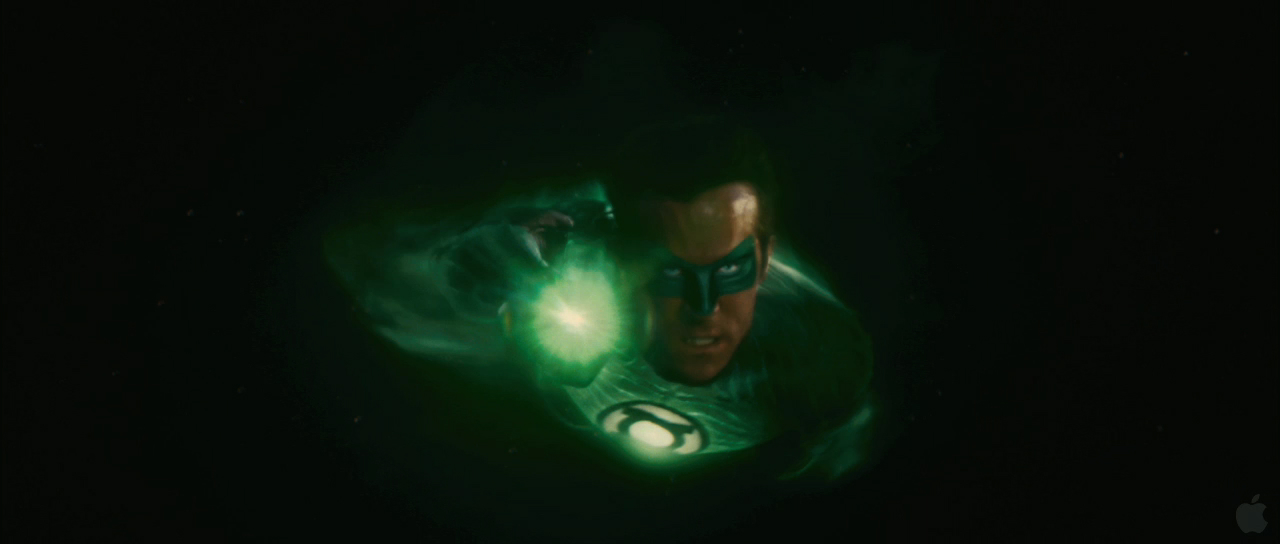
I waited until a second screening of 'Green Lantern' to post my review because I wanted to make for certain that I was watching the same movie as everyone else. As far as I can tell, I was. Yet I still do not fully understand all the negative criticism thrown at this film. I say I do not fully understand because 'Green Lantern' is not without its problems, but it is far from the incoherent mess some would have you believe. I really enjoyed it. And if you can buy into an intergalactic Corps of superheros watching over the entire universe, and suspend your disbelief, then you should at least be halfway there.
For one thing, maybe my expectations were lower than most. This was perhaps my least anticipated movie of summer what with all the other blockbusters bombarding theaters these days. I also confess my general lack of knowledge of the Green Lantern comics. Everything I know of the Lanterns, I learned from the DC Comics Encyclopedia. Also, I have never enjoyed much Ryan Reynolds. I generally assume any movie starring him will be full of smarmy lines, and a loosely drawn character that more or less brings the same cocky persona to each new film. Thing is, this is a film that works so hard to show you that he is supposed to be cocky and spouting off sarcastic dialogue but doesn't really succeed; and I found him to be a pretty decent fella.
Let's get the issue out of the way right now. The movie has come under fire for having four, count em', FOUR writers. That is perhaps two or three writers too many. Several characters spend a great deal of time telling Hal Jordan (Ryan Reynolds) what a cocky jerk he is but he never really comes across that way. I don't think that's the fault of Reynolds' performance, I think the screenwriters were trying too hard to force a change between how Hal starts out and how he ends up. But I think Ryan Reynolds gets it right. He takes what is a loosely drawn character on paper, and expresses a range of emotion that the movie intended, but the screenwriters didn't provide. Hal is fearful, yes, but he is also a good guy. In a movie about the power of will vs. fear, why try and do more? His struggle is to overcome fear, not a bad case of cocky prick.
There are a couple plot points and characters that need more room to breathe. The film runs a brisk hour and 55 minutes, but feels a bit overstuffed. I could have done with twenty minutes more development and thirty minutes less exposition. And if you think those are the same thing, look them up because I'm pretty sure the writers did not. For instance, why does Sinestro lecture Hal on his weaknesses and unworthiness to be a lantern, only to seemingly give in to that same weakness on a whim later on? Details that I'm sure the avid followers of the comics know, but are lost on general audiences. Mark Strong's portrayal of Sinestro certainly provides some gravitas to the Oa passages of the movie, but they come off feeling a bit disjointed.
Aside from a stiff performance by Blake Lively as the comely Carol Ferris, everyone else does a pretty good job with the uneven writing. There are certainly some quality lines here, but with four people contributing it makes it hard to sort them all out. I really liked Peter Sarsgaard as Hector Hammond but felt his introduction waxed just this side of awkward and the film needed to spend more time establishing where he fits in with Hal, Carol and the other best friend Tom. Hammond isn't "wasted" though, as many reviews claim. He simply and complexly works as a human viaduct for the ultimate threat to the universe, Parallax! This of course leads to a great many effects sequences, almost all of them rendered in CG.
'Green Lantern' has been directed by Martin Campbell, the director who brought two of the best Bond films to the screen with 'Goldeneye' and 'Casino Royale' and the really slick new 'Zorro' pictures. The action in those movies is fairly practical; done with stuntmen and rigs and really great camera work. Here, Campbell is charged with breathing life into an impractical film and he mostly succeeds. Much has been said about the millions poured into 'Green Lantern' to polish the challenging special effects. Whether it looks like $300 million worth is up for debate, but generally it all looks pretty cool. Really, it would have to considering that the Lantern Ring given to Jordan allows him to harness his imagination and make manifest anything his heart desires.
I'd be interested in seeing a longer cut of the film. I really had a good time with this one and I imagine the blu-ray will look astonishing. With a couple less writers, it would certainly be a more focused story that doesn't bite off more than it can chew. Perhaps Warner Brothers got ahead of themselves after the success of another DC Comics property that Christopher Nolan shattered expectations with. $300 million is a lot to bank on a lesser-known hero than the Dark Knight. But you know what? It isn't all that bad. Maybe the producers didn't think one writer would have enough imagination or will to dream up something really awesome. Good thing Hal Jordan puts them in their place with that nifty ring.
For one thing, maybe my expectations were lower than most. This was perhaps my least anticipated movie of summer what with all the other blockbusters bombarding theaters these days. I also confess my general lack of knowledge of the Green Lantern comics. Everything I know of the Lanterns, I learned from the DC Comics Encyclopedia. Also, I have never enjoyed much Ryan Reynolds. I generally assume any movie starring him will be full of smarmy lines, and a loosely drawn character that more or less brings the same cocky persona to each new film. Thing is, this is a film that works so hard to show you that he is supposed to be cocky and spouting off sarcastic dialogue but doesn't really succeed; and I found him to be a pretty decent fella.
Let's get the issue out of the way right now. The movie has come under fire for having four, count em', FOUR writers. That is perhaps two or three writers too many. Several characters spend a great deal of time telling Hal Jordan (Ryan Reynolds) what a cocky jerk he is but he never really comes across that way. I don't think that's the fault of Reynolds' performance, I think the screenwriters were trying too hard to force a change between how Hal starts out and how he ends up. But I think Ryan Reynolds gets it right. He takes what is a loosely drawn character on paper, and expresses a range of emotion that the movie intended, but the screenwriters didn't provide. Hal is fearful, yes, but he is also a good guy. In a movie about the power of will vs. fear, why try and do more? His struggle is to overcome fear, not a bad case of cocky prick.
There are a couple plot points and characters that need more room to breathe. The film runs a brisk hour and 55 minutes, but feels a bit overstuffed. I could have done with twenty minutes more development and thirty minutes less exposition. And if you think those are the same thing, look them up because I'm pretty sure the writers did not. For instance, why does Sinestro lecture Hal on his weaknesses and unworthiness to be a lantern, only to seemingly give in to that same weakness on a whim later on? Details that I'm sure the avid followers of the comics know, but are lost on general audiences. Mark Strong's portrayal of Sinestro certainly provides some gravitas to the Oa passages of the movie, but they come off feeling a bit disjointed.
Aside from a stiff performance by Blake Lively as the comely Carol Ferris, everyone else does a pretty good job with the uneven writing. There are certainly some quality lines here, but with four people contributing it makes it hard to sort them all out. I really liked Peter Sarsgaard as Hector Hammond but felt his introduction waxed just this side of awkward and the film needed to spend more time establishing where he fits in with Hal, Carol and the other best friend Tom. Hammond isn't "wasted" though, as many reviews claim. He simply and complexly works as a human viaduct for the ultimate threat to the universe, Parallax! This of course leads to a great many effects sequences, almost all of them rendered in CG.
'Green Lantern' has been directed by Martin Campbell, the director who brought two of the best Bond films to the screen with 'Goldeneye' and 'Casino Royale' and the really slick new 'Zorro' pictures. The action in those movies is fairly practical; done with stuntmen and rigs and really great camera work. Here, Campbell is charged with breathing life into an impractical film and he mostly succeeds. Much has been said about the millions poured into 'Green Lantern' to polish the challenging special effects. Whether it looks like $300 million worth is up for debate, but generally it all looks pretty cool. Really, it would have to considering that the Lantern Ring given to Jordan allows him to harness his imagination and make manifest anything his heart desires.
I'd be interested in seeing a longer cut of the film. I really had a good time with this one and I imagine the blu-ray will look astonishing. With a couple less writers, it would certainly be a more focused story that doesn't bite off more than it can chew. Perhaps Warner Brothers got ahead of themselves after the success of another DC Comics property that Christopher Nolan shattered expectations with. $300 million is a lot to bank on a lesser-known hero than the Dark Knight. But you know what? It isn't all that bad. Maybe the producers didn't think one writer would have enough imagination or will to dream up something really awesome. Good thing Hal Jordan puts them in their place with that nifty ring.
Monday, June 13, 2011
It Doesn't Matter If You're Black and White
The animation in "Kung Fu Panda 2" is a visual wonder that had me amazed at just how far animation has come in the last several years. This wonderful family entertainment is filled with some of the most slick action sequences of the summer and it's a complete blast from beginning to end. It may be a summer full of sequels, reboots and tent poles, but this is one done exceptionally well. "Kung Fu Panda 2" surpasses it's predecessor with more of the increasingly impressive animation from Dreamworks Studios and a story full of heart.
The film starts with a prologue that matches the animation style of the original film's opening. We are introduced to the tyrannical peacock Lord Shen (voiced by the always impressive Gary Oldman), who is far more menacing than he might sound. Lord Shen is the heir to rule Gongmen City, but decides that if he can have a city, why not have all of China? His evil acts are partially motivated by a grim prophecy given by a soothsayer goat, or is it a goat soothsayer? This set up ties to Po's past in a startling way, which I will leave for you to discover. Suffice it to say that while Lord Shen may not be skilled in Kung Fu, he has other plans that involve nothing more or less than to use a giant dragon gun to destroy Kung Fu as China knows it, and this, my friends, just will not do. For Po, or the rest of the furious five.
Comprising the furious five are all the beloved characters of the original "Kung Fu Panda" voiced by their respective talents. Angelina Jolie returns as Tigress, Jackie Chan as Monkey, Seth Rogan as Seth Rogan pretending to be a Mantis, Lucy Liu as Viper and the spread-thin David Cross as Crane. Lest we forget that these characters represent various styles of Martial arts but that is beside the point. Each is given a fair amount of time to show a bit of talent, but of course the real star is Po, who, as the film opens, has clearly been progressing with his kung fu. An early sequence has the gang fighting off vicious wolves and aside from providing inspired action, it triggers some repressed memories in Po and this starts the plot moving.
While "Kung Fu Panda 2" easily has twice the action of the first movie, none of the action here feels forced or strung together by weak plot threads. Each sequence has purpose and springs from the exuberance and focus of the story. It's easy for many sequels, especially animated ones, to feel like cash grabs for the studio when a film has been a success. The original "Kung Fu Panda" indeed brought home the big bucks, but it seems as though extreme care and originality was brought to the table here to not only expand the world of the original movie but to create something unique and worth telling. Jonathan Aibel and Glenn Berger have provided a script that doesn't feel as forced with the humor as did the first film. Here the lines are natural and flow as smoothly as Master Shifu (Dustin Hoffman) when finding inner peace.
Yet the real standout is what "Kung Fu Panda 2" sets out to do for the characters. One might assume Po has more lessons to learn and secrets to discover. Secrets like, why is his father a goose? Why aren't there a ton of other Pandas around? And just how much can an overweight Panda improve in specialized combat? The movie sets out to tackle these questions and more. Discovery is a prevalent theme here and the best part is that it sends a nice message to the audience without feeling too heavy-handed. During the climax of the film, Po has to face some dark revelations about his past, and the way that he handles this revelation and what it allows him to become is really very touching.
Jennifer Yuh, who worked as a story artist on the first film, has directed the sequel and the movie pays off with an energy that suggests she was ready to spring forward and hit the ground running. That's really sort of nice when a film like "Kung Fu Panda 2" has something to prove with audiences. I mean, how many stories about a Panda martial artist can you tell and have the audience keep coming? The end of the film suggests perhaps quite a bit. I don't mind saying I could easily sit through another chapter of Po's adventures. The only thing that could have made my experience with this film less enjoyable is if I had seen it in 3D. It would be a shame to watch all those bright colors and fantastic animation be diminished. Maybe Lord Shen should focus his dragon gun on that third dimension.
The film starts with a prologue that matches the animation style of the original film's opening. We are introduced to the tyrannical peacock Lord Shen (voiced by the always impressive Gary Oldman), who is far more menacing than he might sound. Lord Shen is the heir to rule Gongmen City, but decides that if he can have a city, why not have all of China? His evil acts are partially motivated by a grim prophecy given by a soothsayer goat, or is it a goat soothsayer? This set up ties to Po's past in a startling way, which I will leave for you to discover. Suffice it to say that while Lord Shen may not be skilled in Kung Fu, he has other plans that involve nothing more or less than to use a giant dragon gun to destroy Kung Fu as China knows it, and this, my friends, just will not do. For Po, or the rest of the furious five.
Comprising the furious five are all the beloved characters of the original "Kung Fu Panda" voiced by their respective talents. Angelina Jolie returns as Tigress, Jackie Chan as Monkey, Seth Rogan as Seth Rogan pretending to be a Mantis, Lucy Liu as Viper and the spread-thin David Cross as Crane. Lest we forget that these characters represent various styles of Martial arts but that is beside the point. Each is given a fair amount of time to show a bit of talent, but of course the real star is Po, who, as the film opens, has clearly been progressing with his kung fu. An early sequence has the gang fighting off vicious wolves and aside from providing inspired action, it triggers some repressed memories in Po and this starts the plot moving.
While "Kung Fu Panda 2" easily has twice the action of the first movie, none of the action here feels forced or strung together by weak plot threads. Each sequence has purpose and springs from the exuberance and focus of the story. It's easy for many sequels, especially animated ones, to feel like cash grabs for the studio when a film has been a success. The original "Kung Fu Panda" indeed brought home the big bucks, but it seems as though extreme care and originality was brought to the table here to not only expand the world of the original movie but to create something unique and worth telling. Jonathan Aibel and Glenn Berger have provided a script that doesn't feel as forced with the humor as did the first film. Here the lines are natural and flow as smoothly as Master Shifu (Dustin Hoffman) when finding inner peace.
Yet the real standout is what "Kung Fu Panda 2" sets out to do for the characters. One might assume Po has more lessons to learn and secrets to discover. Secrets like, why is his father a goose? Why aren't there a ton of other Pandas around? And just how much can an overweight Panda improve in specialized combat? The movie sets out to tackle these questions and more. Discovery is a prevalent theme here and the best part is that it sends a nice message to the audience without feeling too heavy-handed. During the climax of the film, Po has to face some dark revelations about his past, and the way that he handles this revelation and what it allows him to become is really very touching.
Jennifer Yuh, who worked as a story artist on the first film, has directed the sequel and the movie pays off with an energy that suggests she was ready to spring forward and hit the ground running. That's really sort of nice when a film like "Kung Fu Panda 2" has something to prove with audiences. I mean, how many stories about a Panda martial artist can you tell and have the audience keep coming? The end of the film suggests perhaps quite a bit. I don't mind saying I could easily sit through another chapter of Po's adventures. The only thing that could have made my experience with this film less enjoyable is if I had seen it in 3D. It would be a shame to watch all those bright colors and fantastic animation be diminished. Maybe Lord Shen should focus his dragon gun on that third dimension.
Saturday, June 11, 2011
Kids These Days
You'd be hard pressed to find a review for "Super 8" that doesn't compare it to one of J.J. Abrams' or Steven Spielberg's previous films, or to one of those "Amblin films from the 80's," although I found myself hard pressed to think of one besides "E.T." and "The Goonies." J.J. Abrams clearly set out to show his love for those movies and bring about the same sense of wonder; and while "Super 8" certainly evokes a bit of nostalgia from the films of that era and aims to have just as much fun, if someone says "they don't make em' like they used to", well, they'd be right.
Not that there is anything inherently wrong with "Super 8," it's a wonderful entertainment that lives up to the sense of mystery built up by it's secretive marketing campaign. It's just that nothing here is really innovative. Abrams, along with Producer Steven Spielberg, combine elements from many different films, some of them their own, and create something that definitely reaches for the lofty goals of those 80's benchmarks, but falls just short. First of all, one of the main attractions of the movie, which remains successfully hidden until nearly the third act, bares an astonishing resemblance to an element from one of J.J. Abrams' previous features. It got me thinking: "hey, I've seen this before." This could be an issue of the design team, but I had just hoped for something a little more unexpected. A couple minor tonal shifts also keep things just off balance, and we're reminded of just how well blended those films of yester-year were.
I don't mean to make this review sound negative. On the contrary, I loved "Super 8"; I just aim to point out that it does not need to be the next "E.T." to become a success. In fact, one of it's strongest merits is that it trusts its child actors to carry a film of this magnitude. Just like "The Goonies" and "E.T" before it, "Super 8" spends most of it's time with adolescent protagonists. Joel Courtney as Joe Lamb is instinctive in evoking the thoughts and emotions weighing on a boy of his age. Considering the story takes place in the late 1970's, and with all the different threads going on here, the fact that the emotional through-line rests almost single-handedly on his shoulders is impressive. Strangely, it's when the story diverts to the adult characters that it begins to bog itself down. Kyle Chandler is a standout actor, but here as Joe's dad and a Deputy Sheriff, his role screams "I'm here for the adults in the audience!" If the filmmakers had relied on the kids more, they would have realized that the adults in the audience don't require an adult actor for levity because the kids provide it all.
As Alice, Elle Fanning is nothing short of show-stopping. Watch her closely filming the scene as part of the character Charles' (Riley Griffiths) movie; she is a classic actress in the making. Ron Eldard also appears as her father and it took me more than half the movie before I recognized him. He is an under-utilized actor and his performance here is a highlight. The film certainly has some "hey, it's THAT guy" moments, but using relatively unknown child actors was a risk that absolutely paid off. There is talent in spades here, both in front of and behind the camera. "Super 8," in a way, is actually a sum of risks that Abrams took to supply a modern audience with the wonderment of the films that he, and some of us, grew up on.
Notice I have said virtually nothing about the plot. This is to your advantage if you have not yet seen the film. I read almost nothing about it before my viewing tonight as I wanted to go in blind to whatever secrets "Super 8" might conceal. Conceal secrets, it does, and some pay-offs are better than others. You owe it to yourself to watch it and discover which ones work for you. Most of what is here worked for me, one of them being, quite surprisingly, the film-within-the-movie that the young boys are shooting on the 8mm film referenced in the title The audience is eventually rewarded with seeing it in it's entirety and I found myself curious to discover if J.J. Abrams left the young actors to actually create it themselves.
"Super 8" does not achieve everything it sets out to. It meanders one too many times and borrows heavily from elements of various great films that have come before it. Yet, that the audience can recognize those elements, realize that they are expertly done and be pleasantly reminded of those great "80's Amblin films" is an achievement in itself. J.J. Abrams pays wonderful homage to the movies we loved in our youth and updates some of that magic here. It may not be the most innovative film of summer or as timeless as the classics, but it is certainly a great deal more than "E.T. with lens flare", and that's just, well......super.
Not that there is anything inherently wrong with "Super 8," it's a wonderful entertainment that lives up to the sense of mystery built up by it's secretive marketing campaign. It's just that nothing here is really innovative. Abrams, along with Producer Steven Spielberg, combine elements from many different films, some of them their own, and create something that definitely reaches for the lofty goals of those 80's benchmarks, but falls just short. First of all, one of the main attractions of the movie, which remains successfully hidden until nearly the third act, bares an astonishing resemblance to an element from one of J.J. Abrams' previous features. It got me thinking: "hey, I've seen this before." This could be an issue of the design team, but I had just hoped for something a little more unexpected. A couple minor tonal shifts also keep things just off balance, and we're reminded of just how well blended those films of yester-year were.
I don't mean to make this review sound negative. On the contrary, I loved "Super 8"; I just aim to point out that it does not need to be the next "E.T." to become a success. In fact, one of it's strongest merits is that it trusts its child actors to carry a film of this magnitude. Just like "The Goonies" and "E.T" before it, "Super 8" spends most of it's time with adolescent protagonists. Joel Courtney as Joe Lamb is instinctive in evoking the thoughts and emotions weighing on a boy of his age. Considering the story takes place in the late 1970's, and with all the different threads going on here, the fact that the emotional through-line rests almost single-handedly on his shoulders is impressive. Strangely, it's when the story diverts to the adult characters that it begins to bog itself down. Kyle Chandler is a standout actor, but here as Joe's dad and a Deputy Sheriff, his role screams "I'm here for the adults in the audience!" If the filmmakers had relied on the kids more, they would have realized that the adults in the audience don't require an adult actor for levity because the kids provide it all.
As Alice, Elle Fanning is nothing short of show-stopping. Watch her closely filming the scene as part of the character Charles' (Riley Griffiths) movie; she is a classic actress in the making. Ron Eldard also appears as her father and it took me more than half the movie before I recognized him. He is an under-utilized actor and his performance here is a highlight. The film certainly has some "hey, it's THAT guy" moments, but using relatively unknown child actors was a risk that absolutely paid off. There is talent in spades here, both in front of and behind the camera. "Super 8," in a way, is actually a sum of risks that Abrams took to supply a modern audience with the wonderment of the films that he, and some of us, grew up on.
Notice I have said virtually nothing about the plot. This is to your advantage if you have not yet seen the film. I read almost nothing about it before my viewing tonight as I wanted to go in blind to whatever secrets "Super 8" might conceal. Conceal secrets, it does, and some pay-offs are better than others. You owe it to yourself to watch it and discover which ones work for you. Most of what is here worked for me, one of them being, quite surprisingly, the film-within-the-movie that the young boys are shooting on the 8mm film referenced in the title The audience is eventually rewarded with seeing it in it's entirety and I found myself curious to discover if J.J. Abrams left the young actors to actually create it themselves.
"Super 8" does not achieve everything it sets out to. It meanders one too many times and borrows heavily from elements of various great films that have come before it. Yet, that the audience can recognize those elements, realize that they are expertly done and be pleasantly reminded of those great "80's Amblin films" is an achievement in itself. J.J. Abrams pays wonderful homage to the movies we loved in our youth and updates some of that magic here. It may not be the most innovative film of summer or as timeless as the classics, but it is certainly a great deal more than "E.T. with lens flare", and that's just, well......super.
Friday, June 3, 2011
The NeXt Stage in Evolution...or is it the first?
When Bryan Singer took a chance at bringing comic book movies back into the mainstream with the first "X-Men" feature, he created a visual marvel with relevant ideas that revolutionized the genre for this generation. Solid performances, impressive effects and top-caliber direction started a franchise that had potential to evolve into something great. Alas, Singer stepping away from the X-Men after the even better "X2" only gave us diminishing returns that stopped being about anything but summer special effects spectacle. The third and fourth films in the Marvel canon of X-Men films were watchable mostly for Hugh Jackman's visceral take on Wolverine. Good thing that Bryan Singer involved himself with "X-Men: First Class" as a story contributor and Producer, because it's a return to form that actually surpasses the first two, with much due credit to director Matthew Vaughn.
"X-Men: First Class" re-introduces us to Charles Xavier (Professor X), here played with great levity by an ever-impressive James McAvoy, and Erik Lehnsherr (Magneto), played by Michael Fassbender. The story opens with a re-creation of the opening scene of the original "X-Men." The scene re-establishes the horrors that young Erik Lehnsherr endured during childhood, and indeed, the evil mutant Sebastian Shaw (Kevin Bacon) motivates Erik's rage, and subsequent power with a cruel action. We also see the college student version of Charles as a womanizing lush who is wicked smart about genetic mutations that cause unique human traits. If the girls he picks up on only knew. These two men will eventually meet as a result of mounting circumstances that call for both their 'talents'. The details of these circumstances I will leave you to discover, but in broad strokes, it involves a World War III hungry Sebastian Shaw courting the Russians during the turbulent period in the 1960s when a nuclear crisis was on everyones' mind. Good thing Charles can see what's on everyones' mind. For the most part.
My minor quibble with the first few "X-Men" films was the thinly veiled allegory for various "Rights" issues. Bryan Singer and third chapter director Brett Ratner seemed to muddle around with too many ideas. Gay rights? Civil rights? Animal rights? Pick one. The problem was that the movies weren't brave enough to fully embrace any one of those issues and so the human cost got lost among all the special effects and comic-book dialogue. "X-Men: First Class" succeeds by framing the story right in the middle of the Cuban Missile crisis and making no bones about the fact that these mutants are a presence to be reckoned with. This movie is about mutants, yes, but for once it isn't contained in it's own little world. The first film dabbled with a congressman who gives an impassioned speech about the threat of mutants in society, but that subplot bursts faster than the congressman. The scope of "X-Men: First Class" stretches itself to the world at large so that the stakes seem extremely high for mutants and humans alike.
Matthew Vaughn's direction is a revelation. The first preview sort of had me scoffing at the prospect of the film, yet Vaughn takes the material very seriously and I found myself quite surprised at how emotionally invested I became. As the movie progresses, threats loom on all sides and the sense of foreboding increases as we realize what must become of this partnership between Erik and Charles. Indeed, Erik has good reason for hating humanity as he has come to experience it. Yet we also see Charles' missteps as he regards regular humans more like science projects than as equals. Both men have an undeniable logic that each believe cannot be compromised. This concept creates a feud that neither want, but that neither can avoid.
The visual and special effects are astonishing. I mentioned in my review of "Thor" that it did not rely on special effects to tell it's story. That's even more true here in a film full of characters with marvelous powers; yet it never feels like the movie is showing off. The powers make sense and contribute the relevant nature of the impending crisis. The human reactions to the unleashed abilities ring true for the audience as well: this is some pretty sweet stuff that the X-Men get up to. A key sequence involves an attack on a CIA compound, and Vaughn doesn't use quick-cuts to hide anything; there is really nothing to hide since the effects blend expertly with the live action.
"X-Men: First Class" is probably the most relevant blockbuster of the summer so far. It's a re-invigoration of a franchise that was beginning to plateau into auto-pilot. Matthew Vaughn steers it into new territory with an origin story that sets a new bar for future installments. Here is another stand out film in the pantheon of comic blockbusters that is really about something. The film's ability to not be shy with it's concepts or execution makes me excited to see how a sequel might further bridge the gap between this film and the first "X-Men". Speaking of which, a very common thread in all the X-Men films pops up very briefly here. No prizes for guessing what..or who it is, bub.
"X-Men: First Class" re-introduces us to Charles Xavier (Professor X), here played with great levity by an ever-impressive James McAvoy, and Erik Lehnsherr (Magneto), played by Michael Fassbender. The story opens with a re-creation of the opening scene of the original "X-Men." The scene re-establishes the horrors that young Erik Lehnsherr endured during childhood, and indeed, the evil mutant Sebastian Shaw (Kevin Bacon) motivates Erik's rage, and subsequent power with a cruel action. We also see the college student version of Charles as a womanizing lush who is wicked smart about genetic mutations that cause unique human traits. If the girls he picks up on only knew. These two men will eventually meet as a result of mounting circumstances that call for both their 'talents'. The details of these circumstances I will leave you to discover, but in broad strokes, it involves a World War III hungry Sebastian Shaw courting the Russians during the turbulent period in the 1960s when a nuclear crisis was on everyones' mind. Good thing Charles can see what's on everyones' mind. For the most part.
My minor quibble with the first few "X-Men" films was the thinly veiled allegory for various "Rights" issues. Bryan Singer and third chapter director Brett Ratner seemed to muddle around with too many ideas. Gay rights? Civil rights? Animal rights? Pick one. The problem was that the movies weren't brave enough to fully embrace any one of those issues and so the human cost got lost among all the special effects and comic-book dialogue. "X-Men: First Class" succeeds by framing the story right in the middle of the Cuban Missile crisis and making no bones about the fact that these mutants are a presence to be reckoned with. This movie is about mutants, yes, but for once it isn't contained in it's own little world. The first film dabbled with a congressman who gives an impassioned speech about the threat of mutants in society, but that subplot bursts faster than the congressman. The scope of "X-Men: First Class" stretches itself to the world at large so that the stakes seem extremely high for mutants and humans alike.
Matthew Vaughn's direction is a revelation. The first preview sort of had me scoffing at the prospect of the film, yet Vaughn takes the material very seriously and I found myself quite surprised at how emotionally invested I became. As the movie progresses, threats loom on all sides and the sense of foreboding increases as we realize what must become of this partnership between Erik and Charles. Indeed, Erik has good reason for hating humanity as he has come to experience it. Yet we also see Charles' missteps as he regards regular humans more like science projects than as equals. Both men have an undeniable logic that each believe cannot be compromised. This concept creates a feud that neither want, but that neither can avoid.
The visual and special effects are astonishing. I mentioned in my review of "Thor" that it did not rely on special effects to tell it's story. That's even more true here in a film full of characters with marvelous powers; yet it never feels like the movie is showing off. The powers make sense and contribute the relevant nature of the impending crisis. The human reactions to the unleashed abilities ring true for the audience as well: this is some pretty sweet stuff that the X-Men get up to. A key sequence involves an attack on a CIA compound, and Vaughn doesn't use quick-cuts to hide anything; there is really nothing to hide since the effects blend expertly with the live action.
"X-Men: First Class" is probably the most relevant blockbuster of the summer so far. It's a re-invigoration of a franchise that was beginning to plateau into auto-pilot. Matthew Vaughn steers it into new territory with an origin story that sets a new bar for future installments. Here is another stand out film in the pantheon of comic blockbusters that is really about something. The film's ability to not be shy with it's concepts or execution makes me excited to see how a sequel might further bridge the gap between this film and the first "X-Men". Speaking of which, a very common thread in all the X-Men films pops up very briefly here. No prizes for guessing what..or who it is, bub.
Subscribe to:
Posts (Atom)